
农业大数据学报 ›› 2026, Vol. 8 ›› Issue (1): 72-85.doi: 10.19788/j.issn.2096-6369.000132
李梦瑄( )
)
收稿日期:2025-09-04
接受日期:2025-10-29
出版日期:2026-03-26
发布日期:2026-04-01
作者简介:李梦瑄,E-mail:limengxuan0422@163.com。
LI MengXuan()
Received:2025-09-04
Accepted:2025-10-29
Published:2026-03-26
Online:2026-04-01
摘要:
数字乡村建设与农业绿色发展是深度融合与良性互动的有机整体,二者的协同演进是驱动农业现代化转型的关键。基于2011—2022年我国黄河流域九省(区)的面板数据,构建数字乡村建设与绿色农业耦合互动的作用机理与综合评价体系,对两者时空演变规律、耦合协调关系及障碍因子进行实证分析。结果表明,各省(区)农业绿色发展与数字乡村建设水平均呈上升趋势,但区域间差异显著。两者耦合协调度呈增长态势,空间分布呈现“下游>上游>中游”的格局,各省区距离优质协调仍有较大差距;主要障碍因子包括:农业机械化程度、耕地复种指数、水资源利用效率、农产品数字交易、移动电话普及率与互联网普及率。未来,应强化政策激励以促进科技创新,特别是聚焦关键障碍因子并实施差异化区域战略以促进数字乡村建设与农业绿色协调发展。
李梦瑄. 黄河流域数字乡村建设与农业绿色发展耦合协调及障碍因子研究[J]. 农业大数据学报, 2026, 8(1): 72-85.
LI MengXuan. Research on the Coupling Coordination and Barrier Factors between Digital Village Construction and Agricultural Green Development in the Yellow River Basin, China[J]. Journal of Agricultural Big Data, 2026, 8(1): 72-85.
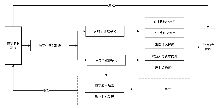
图1
数字乡村建设与农业绿色发展耦合机理"
表1
耦合协调度分析表"
| 协调度D值 | 协调等级 | 协同程度 | 协调度D值 | 协调等级 | 协同程度 |
|---|---|---|---|---|---|
| [0.0, 0.1) | 1 | 极度失调 | [0.5, 0.6) | 6 | 勉强协调 |
| [0.1, 0.2) | 2 | 严重失调 | [0.6, 0.7) | 7 | 初级协调 |
| [0.2, 0.3) | 3 | 中度失调 | [0.7, 0.8) | 8 | 中级协调 |
| [0.3, 0.4) | 4 | 轻度失调 | [0.8, 0.9) | 9 | 良好协调 |
| [0.4, 0.5) | 5 | 濒临失调 | [0.9, 1.0] | 10 | 优质协调 |
表2
农业绿色发展指标体系及权重"
| 目标层 | 准则层 | 指标层 | 指标含义 | 单位 | 属性 | 权重 |
|---|---|---|---|---|---|---|
| 农业绿色发展 | 发展基础 | 土地生产力x1 | 农业总产值/农作物播种面积 | 亿元/ hm2 | + | 0.0852 |
| 农业机械化程度x2 | 农业机械总动力/农作物播种面积 | kW / hm2 | + | 0.1023 | ||
| 财政支农水平x3 | 农林水事务支出/一般公共预算支出 | % | + | 0.0645 | ||
| 资源节约 | 耕地复种指数x4 | 全年作物播种面积/耕地面积 | % | + | 0.1409 | |
| 水资源利用效率x5 | 节水灌溉面积/灌溉总面积 | % | + | 0.1221 | ||
| 单位农业产值耗水量x6 | 农业总耗水量/农业总产值 | m3/hm2 | - | 0.0185 | ||
| 单位农业产值耗电量x7 | 乡村用电量/农业总产值 | kW/万元 | - | 0.0464 | ||
| 环境友好 | 农药使用量x8 | 农用农药施用量/农作物总播种面积 | t/hm2 | - | 0.0295 | |
| 化肥使用量x9 | 农用化肥施用折纯量/农作物总播种面积 | t/hm2 | - | 0.0493 | ||
| 地膜使用量x10 | 地膜施用量/农作物播种面积 | t/hm2 | - | 0.0254 | ||
| 柴油使用量x11 | 柴油使用量/农作物播种面积 | t/hm2 | - | 0.0602 | ||
| 乡村发展 | 乡村居民人均收入x12 | 乡村居民人均可支配收入 | 元/人 | + | 0.0667 | |
| 农业产业结构优化x13 | 农林牧渔服务业总产值/农林牧渔总产值 | % | + | 0.0374 | ||
| 乡村居民生活水平x14 | 休闲农业产值/农业总产值 | % | + | 0.0692 | ||
| 城乡居民收入比x15 | 城镇居民人均可支配收入/乡村居民人均可支配收入 | % | - | 0.0824 |
表3
数字乡村建设指标体系及权重"
| 目标层 | 准则层 | 指标层 | 指标含义 | 单位 | 属性 | 权重 | |||||
|---|---|---|---|---|---|---|---|---|---|---|---|
| 数字乡村建设 | 数字化基础建设 | 互联网普及率y1 | 乡村宽带接入用户数/乡村人口数 | % | + | 0.1207 | |||||
| 移动电话普及率y2 | 乡村居民每百户拥有的移动电话数量 | 部/100户 | + | 0.2496 | |||||||
| 乡村网络投资规模y3 | 数字普惠金融县域网络投资水平 | - | + | 0.0756 | |||||||
| 乡村农业数字化 | 农业气象观测站密度y4 | 农业气象观测站/行政区面积 | 个/万km2 | + | 0.0698 | ||||||
| 数字技术人才y5 | 每千人数字技术人员数 | 人/1000人 | + | 0.1178 | |||||||
| 农业生产电气化程度y6 | 农林牧渔业增加值/乡村用电总量 | 元/度 | + | 0.0947 | |||||||
| 乡村产业数字化 | 农产品数字化交易y7 | 人均电商销售额和采购额 | 万元/人 | + | 0.1739 | ||||||
| 乡村网络支付水平y8 | 数字普惠金融县域移动支付指数 | - | + | 0.0554 | |||||||
| 乡村数字化程度y9 | 数字金融普惠指数中的数字化程度指数 | % | + | 0.0424 | |||||||
表4
2011-2022黄河流域农业绿色发展水平综合指数"
| 年份 | 综合得分 | 发展基础 | 资源节约 | 环境友好 | 乡村发展 |
|---|---|---|---|---|---|
| 2011 | 0.3516 | 0.0703 | 0.1177 | 0.1051 | 0.0586 |
| 2012 | 0.3662 | 0.0787 | 0.1212 | 0.1017 | 0.0646 |
| 2013 | 0.3761 | 0.0851 | 0.0913 | 0.0927 | 0.1070 |
| 2014 | 0.4099 | 0.0901 | 0.1242 | 0.0987 | 0.0969 |
| 2015 | 0.4295 | 0.0984 | 0.1270 | 0.0982 | 0.1059 |
| 2016 | 0.4223 | 0.0790 | 0.1295 | 0.0993 | 0.1144 |
| 2017 | 0.4347 | 0.0823 | 0.1299 | 0.1017 | 0.1208 |
| 2018 | 0.4709 | 0.0912 | 0.1440 | 0.1055 | 0.1302 |
| 2019 | 0.5072 | 0.0947 | 0.1586 | 0.1086 | 0.1452 |
| 2020 | 0.5113 | 0.0995 | 0.1556 | 0.1116 | 0.1446 |
| 2021 | 0.5305 | 0.0997 | 0.1562 | 0.1131 | 0.1614 |
| 2022 | 0.5448 | 0.1046 | 0.1630 | 0.1152 | 0.1621 |
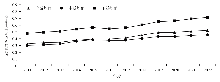
图2
上中下游农业绿色发展水平"
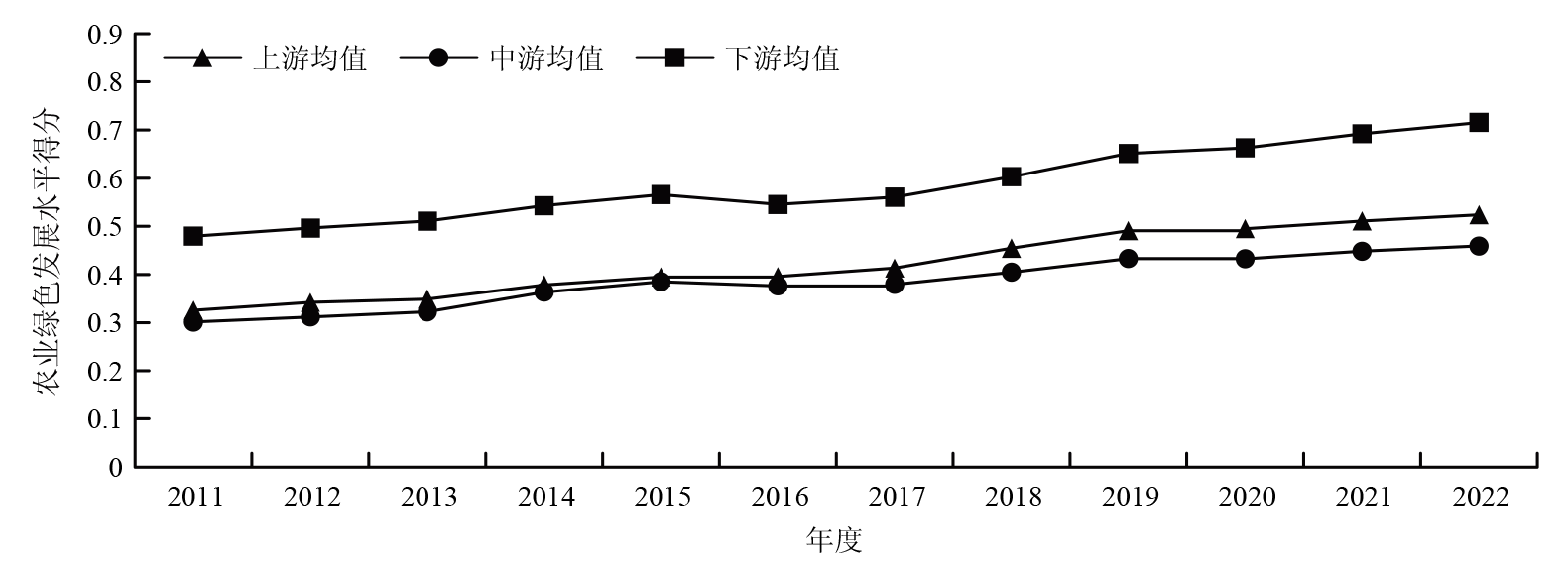
表5
2011-2022黄河流域数字乡村建设水平综合指数"
| 年份 | 综合得分 | 数字化基础 | 乡村农业数字化 | 乡村产业数字化 |
|---|---|---|---|---|
| 2011 | 0.1543 | 0.0556 | 0.0799 | 0.0188 |
| 2012 | 0.1743 | 0.0590 | 0.0889 | 0.0264 |
| 2013 | 0.2164 | 0.0709 | 0.1018 | 0.0437 |
| 2014 | 0.2060 | 0.0670 | 0.0964 | 0.0426 |
| 2015 | 0.2832 | 0.0978 | 0.1017 | 0.0838 |
| 2016 | 0.3016 | 0.1183 | 0.1024 | 0.0809 |
| 2017 | 0.3379 | 0.1502 | 0.1035 | 0.0843 |
| 2018 | 0.3686 | 0.1593 | 0.1070 | 0.1023 |
| 2019 | 0.3955 | 0.1719 | 0.1110 | 0.1127 |
| 2020 | 0.4237 | 0.1827 | 0.1213 | 0.1197 |
| 2021 | 0.4746 | 0.2030 | 0.1259 | 0.1457 |
| 2022 | 0.5258 | 0.2293 | 0.1230 | 0.1734 |
图3
上中下游数字乡村建设水平"
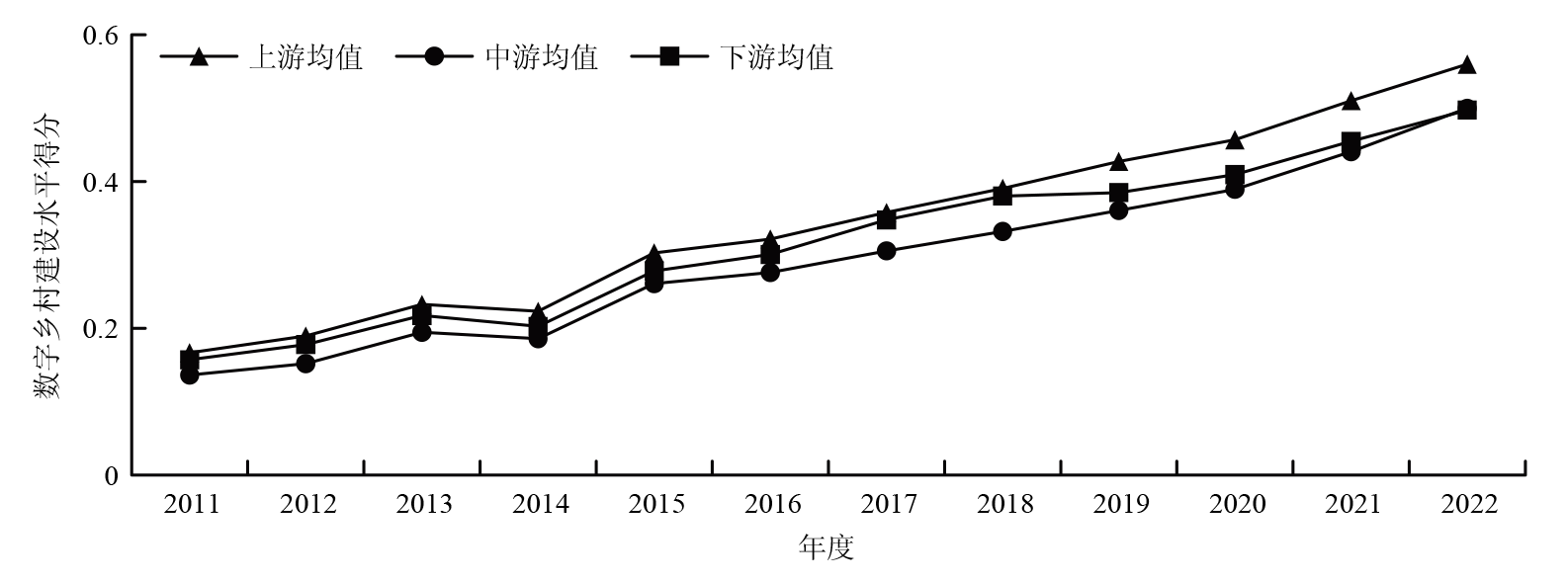
图4
数字乡村建设与农业绿色发展耦合协调度空间特征 注:基于自然资源部标准地图服务网站审图号为GS〔2024〕650号的标准地图制作,底图边界无修改"
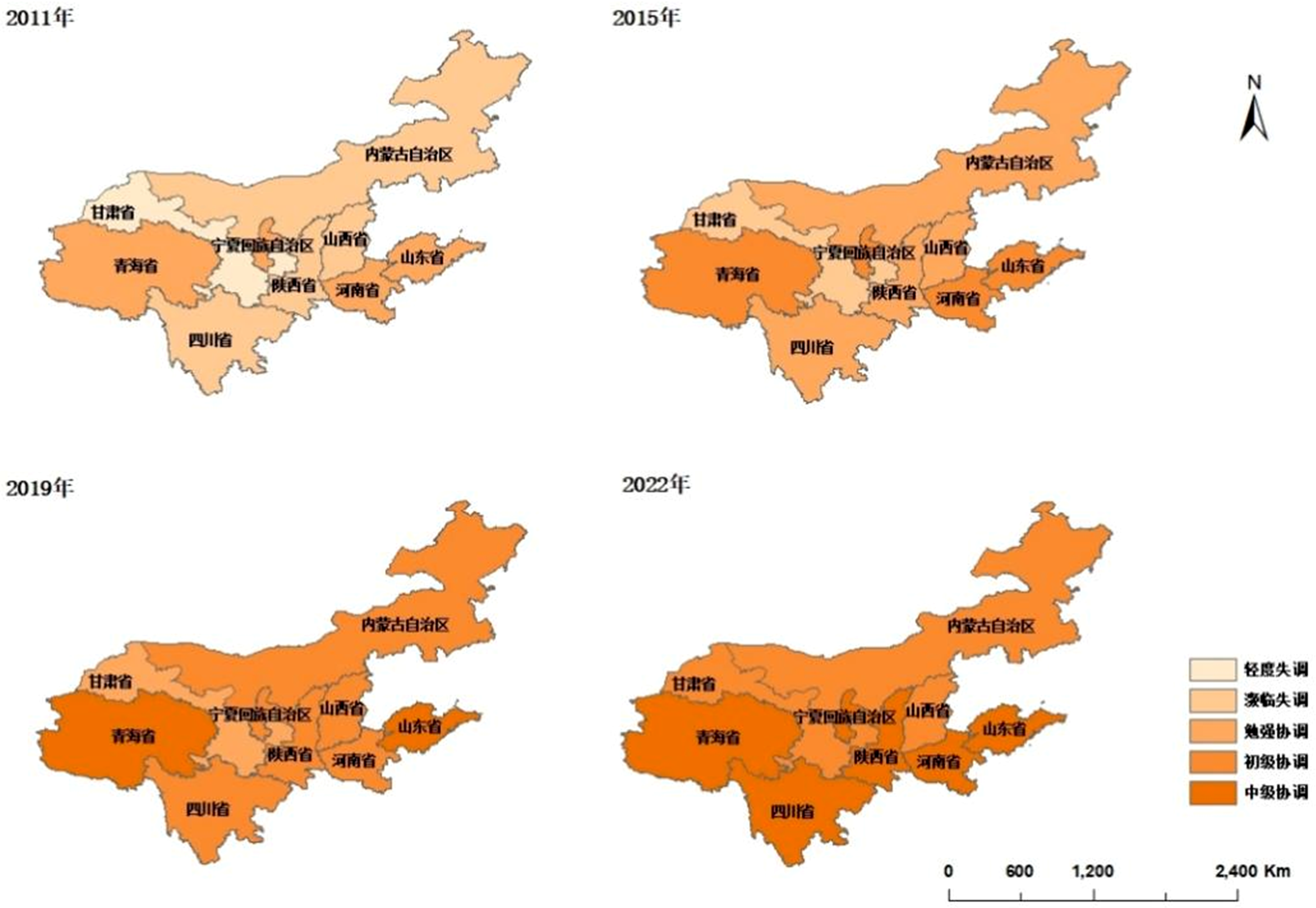
表6
2011-2022绿色农业发展和数字乡村耦合协调度结果"
| 年份 | 甘肃 | 四川 | 宁夏 | 青海 | 内蒙古 | 山西 | 陕西 | 河南 | 山东 | 流域均值 |
|---|---|---|---|---|---|---|---|---|---|---|
| 2011 | 0.3529 | 0.4640 | 0.5291 | 0.5430 | 0.4555 | 0.4707 | 0.4202 | 0.5316 | 0.5160 | 0.4759 |
| 2012 | 0.3809 | 0.4835 | 0.5526 | 0.5617 | 0.4759 | 0.4851 | 0.4359 | 0.5514 | 0.5382 | 0.4961 |
| 2013 | 0.4173 | 0.5210 | 0.5752 | 0.5892 | 0.5147 | 0.5102 | 0.4750 | 0.5779 | 0.5764 | 0.5286 |
| 2014 | 0.4230 | 0.5208 | 0.5781 | 0.6016 | 0.5241 | 0.5147 | 0.4895 | 0.5741 | 0.5776 | 0.5337 |
| 2015 | 0.4783 | 0.5805 | 0.6193 | 0.6476 | 0.5860 | 0.5650 | 0.5364 | 0.6275 | 0.6320 | 0.5858 |
| 2016 | 0.4719 | 0.5913 | 0.6249 | 0.6700 | 0.5996 | 0.5517 | 0.5496 | 0.6302 | 0.6417 | 0.5923 |
| 2017 | 0.5137 | 0.6214 | 0.6513 | 0.6722 | 0.6174 | 0.5654 | 0.5641 | 0.6514 | 0.6765 | 0.6148 |
| 2018 | 0.5509 | 0.6495 | 0.6764 | 0.6980 | 0.6227 | 0.5911 | 0.6005 | 0.6727 | 0.7101 | 0.6413 |
| 2019 | 0.5813 | 0.6852 | 0.6933 | 0.7262 | 0.6339 | 0.6108 | 0.6402 | 0.6943 | 0.7204 | 0.6651 |
| 2020 | 0.5879 | 0.7133 | 0.7052 | 0.7303 | 0.6440 | 0.6178 | 0.6587 | 0.7097 | 0.7334 | 0.6778 |
| 2021 | 0.6174 | 0.7328 | 0.7302 | 0.7578 | 0.6786 | 0.6422 | 0.6777 | 0.7349 | 0.7626 | 0.7038 |
| 2022 | 0.6425 | 0.7592 | 0.7427 | 0.7801 | 0.6997 | 0.6638 | 0.7109 | 0.7479 | 0.7953 | 0.7269 |
| 多年均值 | 0.5015 | 0.6102 | 0.6399 | 0.6648 | 0.5877 | 0.5657 | 0.5632 | 0.6420 | 0.6567 |
表7
农业绿色发展与数字乡村建设主要障碍因子排序"
| 省份 | 农业绿色发展 | 数字乡村建设 | ||
|---|---|---|---|---|
| 因子 | 障碍度 | 因子 | 障碍度 | |
| 山西 | x4 | 0.0841 | y2 | 0.1783 |
| x5 | 0.0681 | y7 | 0.1105 | |
| x2 | 0.0520 | y1 | 0.0716 | |
| 内蒙古 | x9 | 0.0129 | y9 | 0.0107 |
| x8 | 0.0020 | y8 | 0.0266 | |
| x7 | 0.0072 | y7 | 0.0872 | |
| 山东 | x3 | 0.0499 | y2 | 0.2434 |
| x1 | 0.0416 | y7 | 0.0872 | |
| x4 | 0.0397 | y6 | 0.0811 | |
| 河南 | x1 | 0.0499 | y2 | 0.2317 |
| x2 | 0.0492 | y7 | 0.1446 | |
| x3 | 0.0436 | y1 | 0.0801 | |
| 四川 | x2 | 0.0748 | y2 | 0.2187 |
| x5 | 0.0594 | y7 | 0.1280 | |
| x15 | 0.0409 | y5 | 0.0717 | |
| 陕西 | x5 | 0.0703 | y2 | 0.1790 |
| x4 | 0.0620 | y7 | 0.1154 | |
| x2 | 0.0553 | y1 | 0.0621 | |
| 甘肃 | x4 | 0.0905 | y2 | 0.1549 |
| x5 | 0.0788 | y7 | 0.1151 | |
| x2 | 0.0483 | y5 | 0.0684 | |
| 青海 | x5 | 0.0703 | y7 | 0.1364 |
| x4 | 0.0620 | y5 | 0.1148 | |
| x1 | 0.0577 | y1 | 0.0847 | |
| 宁夏 | x4 | 0.0963 | y7 | 0.1381 |
| x5 | 0.0705 | y1 | 0.0785 | |
| x2 | 0.0616 | y5 | 0.0510 | |
| [1] |
赵林, 张春霆, 郭付友, 等. 中国绿色发展与共同富裕协同演化及其驱动因素. 自然资源学报, 2025, 40(8):2177-2194.
doi: 10.31497/zrzyxb.20250811 |
|
ZHAO L, ZHANG C T, GUO F Y, et al. Coordinated evolution and driving factors of green development and common prosperity in China. Journal of Natural Resources, 2025, 40(8):2177-2194.
doi: 10.31497/zrzyxb.20250811 |
|
| [2] | 郭海红. 数字乡村建设、资源要素错配与农业绿色全要素生产率. 中国地质大学学报(社会科学版), 2024, 24(1):102-116. |
| GUO H H. Digital rural construction, misallocation of resource elements, and agricultural green total factor productivity. Journal of China University of Geosciences (Social Sciences Edition), 2024, 24(1):102-116. | |
| [3] | 浦徐进, 马柯旭, 王彦芳. 农村数字化对推动农业绿色高质量发展的影响分析. 中国农业资源与区划, 2024, 45(6):83-95. |
| PU X J, MA K X, WANG Y F. Analysis on the impact of rural digitization on promoting green and high-quality agricultural development. Chinese Journal of Agricultural Resources and Regional Planning, 2024, 45(6):83-95. | |
| [4] | 蒋团标, 钟敏, 马国群. 数字经济对农业绿色全要素生产率的影响——基于土地经营效率的中介作用分析. 中国农业大学学报, 2024, 29(4):27-39. |
| JIANG T B, ZHONG M, MA G Q. Impact of digital economy on agricultural green total factor productivity: A mediation analysis based on land operation efficiency. Journal of China Agricultural University, 2024, 29(4):27-39. | |
| [5] | 刘桉志, 杨树果. 乡村数字化对农业绿色低碳发展的影响——基于耦合协调度和中介效应模型的实证. 农业资源与环境学报, 2024, 41(5):1211-1219. |
| YANG S G. Impact of rural digitization on agricultural green and low-carbon development: empirical evidence based on coupled coordination degree and mediation effect models. Journal of Agricultural Resources and Environment, 2024, 41(5):1211-1219. | |
| [6] | 朱红根, 周柏樊. 数字乡村建设与农业绿色发展:理论与实证. 世界农业, 2025(3):42-54. |
| ZHU H G, ZHOU B F. Digital rural construction and green agricultural development: Theory and empirical research. World Agriculture, 2025(3):42-54. | |
| [7] | 樊胜岳, 李耀龙, 马晓杰, 等. 数字化水平对农业绿色发展影响的实证研究——基于中国30个省份的面板数据. 世界农业, 2021(12):4-16. |
| FAN S Y, LI Y L, MA X J, et al. An empirical study of the impact of digital level on agricultural green development——Based on the panel data 30 provinces of China. World Agriculture, 2021(12):4-16. | |
| [8] | 刘学侠, 陈传龙. 数字技术推动农业产业结构转型升级路径研究. 行政管理改革, 2022(12):57-65. |
| LIU X X, CHEN C L. The path of digital technology promoting the transformation and upgrading of agricultural industrial structure. Administration Reform, 2022(12):57-65. | |
| [9] | 毛世平, 张琛. 以发展农业新质生产力推进农业强国建设. 农业经济问题, 2024(4):36-46. |
| MAO S P, ZHANG C. Promote the construction of an agricultural power through the development of new quality agricultural productivity. Issues in Agricultural Economy, 2024(4):36-46. | |
| [10] | 张志新, 李国乾, 宋玉苗. 数字基础设施建设能否促进农业绿色发展?——基于农业绿色全要素生产率视角. 西南金融, 2025(4): 68-83. |
| ZHANG Z X, LI G Q, SONG Y M. Can digital infrastructure development contribute to greening agriculture?——From the perspective of green total factor productivity in agriculture. Southwest Finance, 2025(4):68-83. | |
| [11] | 张杨, 赵伟. 数字经济驱动农业绿色发展: 内在机理与实证检验[J/OL]. 中国生态农业学报(中英文),1-13[2025-08-24]. |
| ZHANG Y, ZHAO W. Digital economy drives green agricultural development: Internal mechanism and empirical test[J/OL]. Chinese Journal of Eco-Agriculture,1-13[2025-08-24]. | |
| [12] | 陈志英, 富祉祎, 马翔宇, 等. 农业数字化对农业绿色发展的影响研究. 生态经济, 2025, 41(7):115-124. |
| CHEN Z Y, FU Z Y, MA X Y, et al. Research on the impact of agricultural digitization on the green development of China’s agriculture. Ecological Economy, 2025, 41(7):115-124. | |
| [13] | 王恒, 方兰. 中国农业数字化与绿色化时空耦合协调关系及驱动力分析. 长江流域资源与环境, 2023, 32(4):868-882. |
| WANG H, FANG L. Analysis of the spatio-temporal coupling and coordination relationship and the driving forces of the digitalization and greening of Chinese agriculture. Resources and Environment in the Yangtze Basin, 2023, 32(4):868-882. | |
| [14] | 陈海龙, 李宛凇, 徐倩, 等. 数字乡村建设对农业绿色全要素生产率提升效应与机制研究. 农业经济与管理, 2025(2):38-51. |
| CHEN H L, LI W S, XU Q, et al. Study on the effect and mechanism of digital village construction on agricultural green total factor productivity. Agricultural Economics and Management, 2025(2):38-51. | |
| [15] | 杨永生, 张宇飞, 雷洪博. 数字乡村与乡村振兴:耦合协调、时空演进及影响因素. 统计与决策, 2025, 41(14):65-70. |
| YANG Y S, ZHANG Y F, LEI H B. Digital villages and rural revitalization: coupling-coordination, spatiotemporal evolution and influencing factors. Statistics & Decision, 2025, 41(14):65-70. | |
| [16] |
李汝资, 白昳, 周云南, 等. 黄河流域水资源利用与经济增长脱钩及影响因素分解. 地理科学, 2023, 43(1):110-118.
doi: 10.13249/j.cnki.sgs.2023.01.012 |
| LI R Z, BAI Y, ZHOU Y N, et al. Decoupling and decomposition of driving factors of water resource sutilization and economic growth in the Yellow River Basin. Geographical Science, 2023, 43(1):110-118. | |
| [17] | 周欣欣, 张永旺, 汪红梅. 黄河流域农业绿色发展与生态保护耦合协调研究. 人民黄河, 2025, 47(4):15-21+27. |
| ZHOU X X, ZHANG Y W, WANG H M. Study on coupling and coordination of agricultural green development and ecological protection in the Yellow River Basin[J]. Yellow River, 2025, 47(4):15-21+27. | |
| [18] | 赵佳丽, 刘舒宁, 王嘉懿. 绿色发展与产业结构优化协同演进关系研究——以黄河流域资源型城市为例. 宏观经济研究, 2025(4): 49-64+111. |
| ZHAO J L, LIU S N, WANG J Y. A study on the synergistic evolutionary relationship between green development and industrial structure optimization: A case study of resource-based cities in the Yellow River Basin. Macroeconomics, 2025(4):49-64+111. | |
| [19] | 查建平, 周霞, 周玉玺. 黄河流域农业绿色发展水平综合评价分析. 中国农业资源与区划, 2022, 43(1):18-28. |
| ZHA J P, ZHOU X, ZHOU Y X. Evaluation of agricultural green development level in the Yellow River. Chinese Journal of Agricultural Resources and Regional Planning, 2022, 43(1):18-28. | |
| [20] | 任保平, 杜宇翔. 黄河流域经济增长-产业发展-生态环境的耦合协同关系. 中国人口·资源与环境, 2021, 31(2):119-129. |
| REN B P, DU Y X. Coupling coordination of economic growth, industrial development and ecology in the Yellow River Basin. China Population, Resources and Environment, 2021, 31(2):119-129. | |
| [21] | 孙炜琳, 王瑞波, 姜茜, 等. 农业绿色发展的内涵与评价研究. 中国农业资源与区划, 2019, 40(4):14-21. |
| SUN W L, WANG R B, JIANG Q, et al. Study on connotation and evaluation of the agricultural green development. Chinese Journal of Agricultural Resources and Regional Planning, 2019, 40(4):14-21. | |
| [22] | 魏琦, 张斌, 金书秦. 中国农业绿色发展指数构建及区域比较研究. 农业经济问题, 2018(11):11-20. |
| WEI Q, ZHANG B, JIN S Q. A Study on construction and regional comparison of agricultural green development index in China. Issues in Agricultural Economy, 2018(11):11-20. | |
| [23] |
苏飞, 吴宝锐, 张平宇, 等. 数字乡村建设与乡村经济韧性耦合协调的时空演进及驱动机制. 地理科学进展, 2025, 44(7):1434-1451.
doi: 10.18306/dlkxjz.2025.07.009 |
|
SU F, WU B R, ZHANG P Y, et al. Spatial and temporal coupling relationship of digital village construction and rural economic resilience in China and mechanism of influence. Progress in Geography, 2025, 44(7):1434-1451.
doi: 10.18306/dlkxjz.2025.07.009 |
|
| [24] | 杜建军, 章友德, 刘博敏, 等. 数字乡村对农业绿色全要素生产率的影响及其作用机制. 中国人口·资源与环境, 2023, 33(2):165-175. |
| DU J J, ZHANG Y D, LIU B M, et al. Impact of digital village construction on agricultural green total factor productivity and its mechanisms. China Population, Resources and Environment, 2023, 33(2):165-175. | |
| [25] | 黄旭. 数字普惠金融对农业产业链韧性的影响——基于双重机器学习的因果推断. 商业研究, 2025(5):46-55. |
| HUANG X. The impact of digital financial inclusion on the resilience of the agricultural chain——From causal inference based on double machine learning. Commercial Research, 2025(5):46-55. | |
| [26] | 周伊佳, 陈军. 农业数字化、数据要素配置与中国农业绿色全要素生产率——基于数据价值链视角. 中国农业资源与区划, 2025, 46(11): 167-184. |
| ZHOU Y J, CHEN J. Agricultural digitalization, allocation of data elements, and green total factor productivity of agriculture——from the perspective of the data value chain. Chinese Journal of Agricultural Resources and Regional Planning, 2025, 46(11):167-184. | |
| [27] |
陈芳淼, 黄慧萍, 杨光, 等. 基于遥感生态指数的黄河流域生态环境质量变化及影响因素分析. 中国沙漠, 2023, 43(4):252-262.
doi: 10.7522/j.issn.1000-694X.2023.00017 |
|
CHEN F M, HUANG H P, YANG G, et al. Research on the dynamic change of the ecological environment and its influencing factors in the Yellow River Basin based on remote sensing ecological index. Journal of Desert Research, 2023, 43(4):252-262.
doi: 10.7522/j.issn.1000-694X.2023.00017 |
|
| [28] | 林丽波. 乡村振兴背景下内蒙古农业绿色发展评价及耦合协调分析. 中国农业资源与区划, 2023, 44(12):21-31. |
| LIN L B. Evaluation and coupling coordination analysis of agricultural green development in InnerMongolia under the background of rural revitalization. Chinese Journal of Agricultural Resources and Regional Planning, 2023, 44(12):21-31. | |
| [29] | 尹健. 黄河流域数字普惠金融与农业绿色发展的耦合关联研究. 价格理论与实践, 2023(6):184-187+212. |
| YIN J. Study on the coupling relationship between digital inclusive finance and agricultural green development in the Yellow River Basin. Price:Theory & Practice, 2023(6):184-187+212. |
| [1] | 费艳颖, 张栩凡. 数字乡村建设背景下农业农村数据安全的法治保障[J]. 农业大数据学报, 2023, 5(3): 11-18. |
| [2] | 王达, 宋超, 张馨幻, 徐雯, 杨念. 京津冀地区绿色金融发展水平与农业碳排放效率耦合度研究[J]. 农业大数据学报, 2022, 4(3): 116-125. |
|
||
