
农业大数据学报 ›› 2026, Vol. 8 ›› Issue (3): 354-372.doi: 10.19788/j.issn.2096-6369.000168
谢能付1,2,3( ), 王晓丽1,2,3,*(), 王馨1,2,3,*(), 孟智博1,2,3, 满芮1,2,3, 赵忠贺1,2,3, 吴昊1,2,3, 吕前杰1,2,3
收稿日期:2026-07-20
接受日期:2024-09-15
出版日期:2026-09-26
发布日期:2026-10-08
通讯作者:
王馨,E-mail:821012530568@caas.cn;作者简介:谢能付,E-mail:xienengfu@caas.cn。
基金资助:
XIE NengFu1,2,3(), WANG XiaoLi1,2,3,*(), WANG Xin1,2,3,*(), MENG ZhiBo1,2,3, MAN Rui1,2,3, ZHAO ZhongHe1,2,3, WU Hao1,2,3, LV QianJie1,2,3
Received:2026-07-20
Accepted:2024-09-15
Published:2026-09-26
Online:2026-10-08
摘要:
农业领域高质量数据集是支撑农业智能模型研发、数字农业应用与科学决策的关键数据基础。现有农业数据集多服务于特定模型训练和局部场景应用,在任务边界、样本代表性、专业标注、跨源互操作、持续维护和AI-ready表达等方面仍存在不足。围绕农业数据强时空异质性、场景依赖性和多源耦合性的特点,本文构建“基础质量层—农业场景适配层—治理复用层”的层级化评价框架,将准确性、完整性、一致性、代表性、任务适配性、跨域泛化性、可追溯性、互操作性、可复用性和合规安全等维度转化为质量证据、量化指标和度量方法。在此基础上,本文进一步梳理农业视觉图像、遥感与地理空间、文本知识和多模态感知数据集的建设现状,揭示农业数据质量问题沿“上游根源—农业特异性成因—质量缺口—应用风险”的传导机制。面向农业大模型和多模态智能应用,本文提出农业AI-ready数据结构应从传统“样本—标签”扩展为“指令—输入—输出—证据—约束”,并强化时序动态对齐、多源语义嵌入、知识/语义对齐和幻觉抑制。最后,本文提出农业高质量数据集全生命周期数据质量治理与逆向溯源框架,强调通过任务定义、分层采样、专家复核、质量评价、版本管理、用户反馈和分级开放,实现数据集从一次性资源建设向持续数据质量治理转变。
谢能付, 王晓丽, 王馨, 孟智博, 满芮, 赵忠贺, 吴昊, 吕前杰. 农业高质量数据集评价框架与全生命周期治理路径[J]. 农业大数据学报, 2026, 8(3): 354-372.
XIE NengFu, WANG XiaoLi, WANG Xin, MENG ZhiBo, MAN Rui, ZHAO ZhongHe, WU Hao, LV QianJie. Agricultural High-Quality Dataset Evaluation Framework and Full- Lifecycle Governance Pathway[J]. Journal of Agricultural Big Data, 2026, 8(3): 354-372.
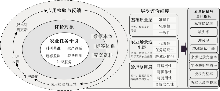
图1
农业高质量数据集层级化评价框架"
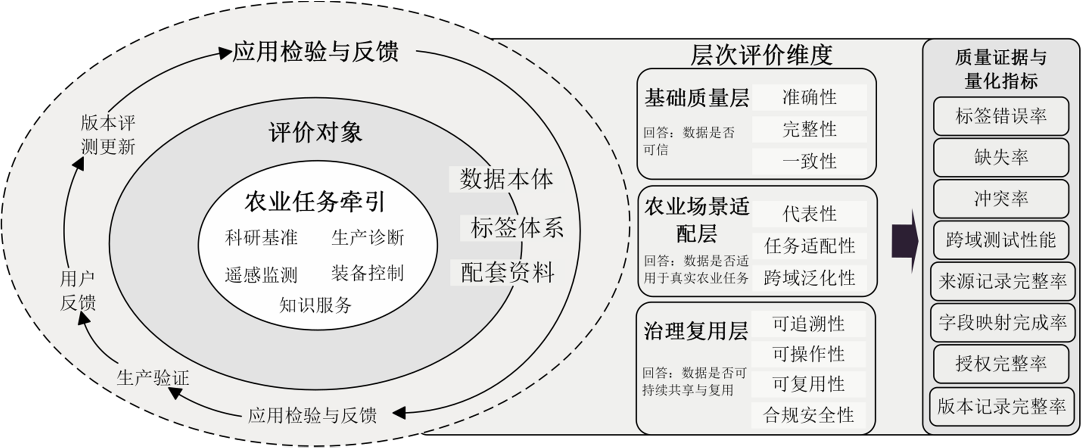
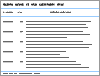
表1
农业高质量数据集层级评价指标体系:质量证据、量化指标与度量"
| 层级 | 评价维度 | 核心问题 | 质量证据 | 可量化指标与度量方法 | 短板指向 |
|---|---|---|---|---|---|
| 基础质量层 | 准确性 | 观测值和标签是否可靠 | 专家复核记录、地面调查结果、传感器校准说明 | 标签错误率=错误标签数/抽检样本数;专家一致率;传感器校准误差 | 干扰模型训练和评测 |
| 基础质量层 | 完整性 | 字段、样本和元数据是否充分 | 元数据清单、字段字典、缺失值处理记录 | 字段缺失率=缺失字段数/应填字段数;样本缺失率;元数据完备率 | 削弱复现和复用价值 |
| 基础质量层 | 一致性 | 空间、时间、语义和格式是否统一 | 坐标系统说明、类别字典、标注边界规则 | 格式冲突率;类别冲突率;坐标/单位一致率;模式冲突率 | 增加数据融合成本 |
| 农业场景适配层 | 代表性 | 样本是否覆盖真实农业差异 | 分层样本清单、跨区域划分、长尾样本说明 | 区域覆盖率;季节覆盖率;生育期覆盖率;长尾类别覆盖率;分布散度 | 造成跨场景泛化不足 |
| 农业场景适配层 | 任务适配性 | 是否匹配具体农业任务 | 任务说明书、标签体系说明、评测任务定义 | 任务标签匹配率;关键场景覆盖率;任务边界完整率 | 导致任务定义泛化 |
| 农业场景适配层 | 跨域泛化性 | 是否支持跨区域、跨年份、跨设备应用 | 跨域测试集、独立验证集、外部评测结果 | 跨域性能下降率=域内性能−域外性能;跨区域测试精度;跨年份测试精度 | 生产场景应用失效 |
| 治理复用层 | 可追溯性 | 数据来源和处理过程是否可审计 | 来源记录、处理流程、版本日志 | 来源记录完整率;处理流程记录率;版本记录完整率 | 降低数据可信度 |
| 治理复用层 | 互操作性 | 是否支持跨平台和多源融合 | 机器可读元数据、标准格式、字段映射表 | 字段映射完成率;标准格式覆盖率;机器可读元数据覆盖率 | 限制跨平台融合 |
| 治理复用层 | 可复用性 | 是否便于再次使用和复现实验 | DOI、数据论文、基准划分、样例代码 | 文档完备率;样例代码可运行率;基准复现率 | 难以支撑长期研究 |
| 治理复用层 | 合规安全 | 是否具备开放边界和安全控制 | 脱敏规则、授权记录、用途限制说明 | 脱敏覆盖率;授权完整率;访问控制记录完整率;用途限制说明完备率 | 阻碍安全开放共享 |
表2
不同农业任务下质量评价权重侧重"
| 农业任务 | 基础质量层 | 农业场景适配层 | 治理复用层 | 权重侧重说明 |
|---|---|---|---|---|
| 遥感作物分类与估产 | 0.30 | 0.45 | 0.25 | 更重视跨区域、跨年份、时序完整性、地面真值一致性和空间代表性 |
| 病虫害识别 | 0.40 | 0.40 | 0.20 | 更重视标签准确性、病害阶段覆盖、田间复杂背景和长尾类别样本 |
| 畜牧多模态监测 | 0.35 | 0.35 | 0.30 | 更重视传感器校准、模态配准、个体追踪、连续记录和隐私合规 |
| 农业文本知识与问答 | 0.35 | 0.30 | 0.35 | 更重视术语一致性、来源可信度、语义对齐、可追溯性和开放复用 |
表3
农业AI-ready数据结构的关键技术环节"
| 技术环节 | 主要问题 | 表达机制 |
|---|---|---|
| 时序动态对齐 | 遥感、气象、土壤和农事记录时间粒度不一致 | 地块ID、时间窗口、生育期标签 |
| 多源异构融合 | 图像、遥感、传感器和文本数据格式差异大 | 跨模态样本ID、统一数据字典 |
| 语义嵌入表示 | 作物、病虫害、生育期等概念不统一 | 农业本体、知识图谱、标准术语表 |
| 指令微调数据 | 传统“样本—标签”结构难以支撑大模型应用 | 指令—输入—输出—证据—约束 |
| 知识/语义对齐 | 大模型回答易脱离农业专业知识和应用语境 | 知识图谱、RAG检索、证据来源标注 |
| 幻觉抑制与审核 | 农技建议、病害诊断和用药建议存在高风险 | 专家审核、风险提示、适用边界说明 |
| 模型评测适配 | 随机划分难以检验真实泛化能力 | 跨区域、跨年份、跨生育期测试集 |
表4
不同数据模态下代表性农业数据集案例及其综述启示"
| 数据模态 | 代表性案例 | 主要业务场景 | 主要价值 | 质量问题 |
|---|---|---|---|---|
| 视觉图像 | PlantVillage、PlantDoc | 病害识别 | 推动病害诊断模型发展 | 实验环境与田间环境迁移落差 |
| 视觉图像 | IP102、DeepWeeds | 害虫识别、杂草分类 | 凸显自然场景和长尾类别价值 | 类别不均衡、尺度变化 |
| 遥感与地理空间 | CropHarvest、Sen4AgriNet | 作物分类、遥感时序建模 | 验证多区域时序样本对泛化的意义 | 地面真值不足、域偏移突出 |
| 地块与资源环境 | EuroCrops、SoilGrids 2.0、WorldClim 2 | 地块开放数据、土壤气候建模 | 支撑跨机构复用与环境变量建模 | 类别体系、分辨率和元数据标准不统一 |
| 文本知识 | AgCNER | 农业实体识别、知识服务 | 拓展农业中文NLP数据基础 | 术语边界、实体嵌套和来源可信度 |
| 多模态感知 | 奶牛多模态、柑橘黄龙病、番茄多模态 | 畜牧监测、病害诊断、果蔬 采收 | 支撑真实生产场景感知 | 模态配准、专家审核和过程追溯不足 |
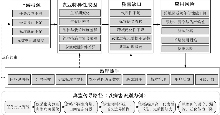
图2
农业数据特异性质量问题的生成与传导机制 "
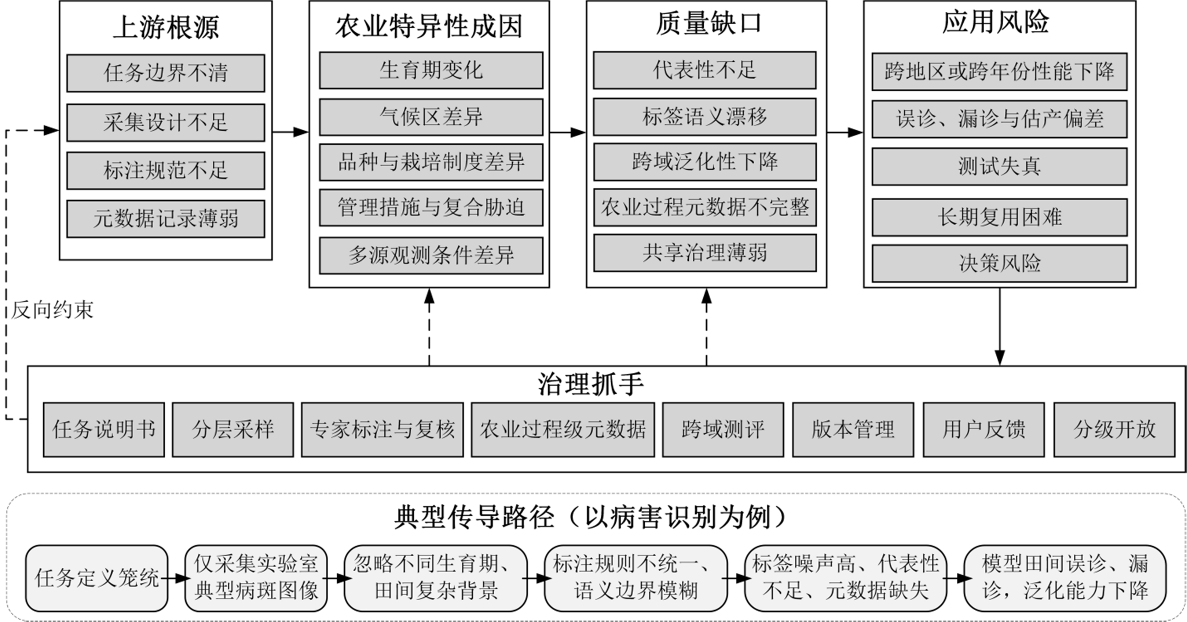
表5
通用数据问题与农业数据特异性质量挑战对照"
| 通用数据问题 | 农业特异性表现 | 深层成因 | 可能质量后果 |
|---|---|---|---|
| 需求边界不清 | 同一数据集难以同时服务病害分类、病斑分割、病害程度评估和防治决策 | 农业任务与作物生育期、管理目标、生产环节高度绑定 | 任务定义泛化,模型应用边界不清 |
| 样本代表性不足 | 样本集中于少数地区、季节、品种或理想拍摄条件 | 作物生长受气候区、栽培制度、品种和田间管理共同影响 | 跨区域、跨年份、跨生育期泛化能力下降 |
| 标签语义漂移 | 同一病害或长势标签在苗期、开花期、成熟期含义不同 | 生物生长过程导致表型连续变化,标签依赖物候阶段 | 标签边界不稳定,训练集与测试集语义不一致 |
| 域偏移 | 同一作物在不同气候区、不同种植制度下呈现不同影像或表型特征 | 气候、土壤、品种、轮作制度和管理措施共同改变数据分布 | 跨气候区、跨种植制度应用失效 |
| 标注可靠性不足 | 病虫害、作物长势、畜禽健康等标签需要专家结合症状、时期和背景判断 | 农业标签依赖植保、农学、畜牧、遥感等领域知识 | 普通标注员难以保证一致性,专家复核成本高 |
| 元数据不完整 | 缺少品种、生育期、气象条件、栽培制度、管理措施等农业上下文 | 农业数据解释高度依赖环境和管理背景 | 数据难以复用,模型误差难以解释 |
| 开放共享受限 | 农户经营数据、地块边界、养殖场视频等难以完全开放 | 涉及隐私、商业秘密、地理位置和生产安全 | 数据开放不足,长期维护和复用困难 |
图3
农业高质量数据集全生命周期数据质量治理与逆向溯源框架"
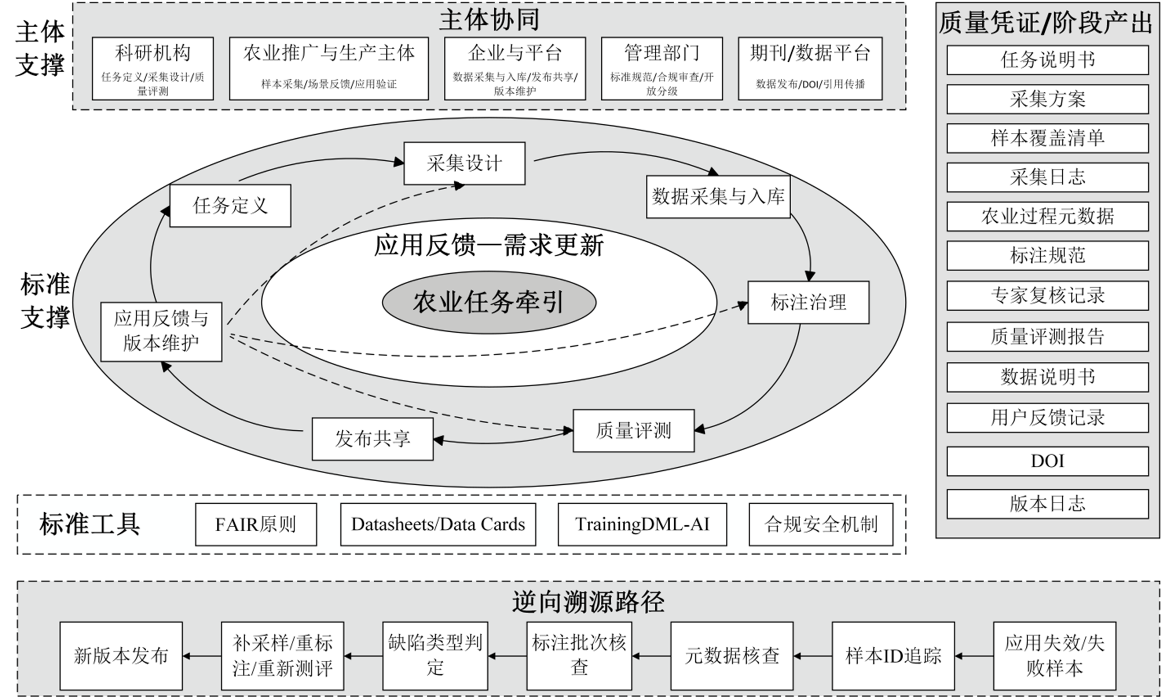
表6
农业数据集全生命周期质量控制节点、质量凭证与修复方式"
| 生命周期阶段 | 质量控制节点 | 质量凭证 | 修复方式 |
|---|---|---|---|
| 任务定义 | 任务目标、适用场景、评价指标和限制场景 | 任务说明书、适用边界说明 | 修订任务范围和限制场景 |
| 采集设计 | 区域、年份、生育期、品种、栽培制度和设备覆盖 | 采集方案、样本覆盖清单 | 补充缺失区域、生育期或设备条件样本 |
| 数据采集与入库 | 格式、缺失值、异常样本和元数据完整性 | 采集日志、数据字典、农业过程级元数据 | 数据清洗、异常修正、补充元数据 |
| 标注治理 | 标注规范、专家一致率、复核比例和争议样本处理 | 标注规范、专家复核记录、争议样本记录 | 修订规范、重新标注、专家仲裁 |
| 质量评测 | 准确性、完整性、代表性和跨域泛化性 | 质量评测报告、跨域评测结果 | 调整测试划分,增加跨域测试集 |
| 发布共享 | 数据说明、授权协议、脱敏处理、版本号和引用方式 | 数据说明书、授权协议、DOI、版本号 | 完善说明文档,调整共享权限 |
| 应用反馈与维护 | 用户反馈、失败样本、失效场景和版本更新 | 用户反馈记录、失败样本清单、版本日志 | 补采样本、修订标注、重新评测、发布新版本 |
表7
农业数据集开放共享类型、治理重点与代表场景"
| 开放类型 | 适用数据 | 治理重点 | 代表场景 |
|---|---|---|---|
| 完全开放 | 低敏科研数据 | 可下载、可引用、可复现 | 公开病虫害图像、通用气候土壤数据 |
| 脱敏开放 | 生产过程数据 | 兼顾复用价值与主体权益 | 农机作业记录、地块管理记录 |
| 授权访问 | 高敏空间或经营数据 | 控制用途、权限和再分发边界 | 高精度地块边界、农户经营数据 |
| 持续服务 | 动态数据产品 | 维护版本、质量置信和反馈机制 | 作物制图产品、农业资源环境数据产品 |
| [1] |
Wolfert S, Ge L, Verdouw C, et al. Big data in smart farming-a review. Agricultural Systems, 2017, 153: 69-80.
doi: 10.1016/j.agsy.2017.01.023 |
| [2] |
Liakos K G, Busato P, Moshou D, et al. Machine learning in agriculture: A review. Sensors, 2018, 18(8): 2674.
doi: 10.3390/s18082674 |
| [3] |
Basso B, Antle J. Digital agriculture to design sustainable agricultural systems. Nature Sustainability, 2020, 3(4): 254-256.
doi: 10.1038/s41893-020-0510-0 |
| [4] |
中国农业科学院农业信息研究所. 农业大数据研究进展(2024). 农业大数据学报, 2024, 6(4): 433-468.
doi: 10.19788/j.issn.2096-6369.200003 |
|
Agricultural Information Institute of CAAS. Progress of agricultural big data research (2024). Journal of Agricultural Big Data, 2024, 6(4): 433-468.
doi: 10.19788/j.issn.2096-6369.200003 |
|
| [5] |
Chamorro-Padial J, García R, Gil R. A systematic review of open data in agriculture. Computers and Electronics in Agriculture, 2024, 219: 108775.
doi: 10.1016/j.compag.2024.108775 |
| [6] |
Whang S E, Roh Y, Song H, et al. Data collection and quality challenges in deep learning: a data-centric AI perspective. The VLDB Journal, 2023, 32:791-813. https://doi.org/10.1007/s00778-022-00775-9.(arXiv:2112.06409)
doi: 10.1007/s00778-022-00775-9 |
| [7] |
Paullada A, Raji I D, Bender E M, et al. Data and its (dis) contents: A survey of dataset development and use in machine learning research. Patterns, 2021, 2(11): 100336.
doi: 10.1016/j.patter.2021.100336 |
| [8] | 管博伦, 张立平, 朱静波, 等. 农业病虫害图像数据集构建关键问题及评价方法综述. 智慧农业(中英文), 2023, 5(3): 17-34. |
|
GUAN B L, ZHANG L P, ZHU J B, et al. The key issues and evaluation methods for constructing agricultural pest and disease image datasets: A review. Smart Agriculture, 2023, 5(3): 17-34.
doi: 10.12133/j.smartag.SA202306012 |
|
| [9] |
姚艳敏, 白玉琪. 农业大数据标准体系框架研究. 农业大数据学报, 2019, 1(4): 76-85.
doi: 10.19788/j.issn.2096-6369.190408 |
|
Yao Y M, Bai Y Q. A Framework for agricultural big data standards. Journal of Agricultural Big Data, 2019, 1(4):76-85.
doi: 10.19788/j.issn.2096-6369.190408 |
|
| [10] | Wang R Y, Strong D M. Beyond accuracy: What data quality means to data consumers. Journal of Management Information Systems, 1996, 12(4): 5-33. |
| [11] | Batini C, Cappiello C, Francalanci C, et al. Methodologies for data quality assessment and improvement. ACM Computing Surveys (CSUR), 2009, 41(3): 1-52. |
| [12] |
Cai L, Zhu Y Y. The challenges of data quality and data quality assessment in the big data era. Data Science Journal, 2015, 14: 2.
doi: 10.5334/dsj-2015-002 |
| [13] | Strong D M, Lee Y W, Wang R Y. Data quality in context. Communications of the ACM, 1997, 40(5): 103-110. |
| [14] | Wang R Y. A product perspective on total data quality management. Communications of the ACM, 1998, 41(2): 58-65. |
| [15] |
Lee Y W, Strong D M, Kahn B K, et al. AIMQ: A methodology for information quality assessment. Information & Management, 2002, 40(2): 133-146.
doi: 10.1016/S0378-7206(02)00043-5 |
| [16] | Saaty T L. The Analytic Hierarchy Process[M]. New York: McGraw- Hill, 1980. |
| [17] | Wilkinson M D, Dumontier M, Aalbersberg I J, et al. The FAIR Guiding Principles for scientific data management and stewardship. Scientific Data, 2016, 3(1): 1-9. |
| [18] |
Ali B, Dahlhaus P. The role of FAIR data towards sustainable agricultural performance: a systematic literature review. Agriculture, 2022, 12(2): 309.
doi: 10.3390/agriculture12020309 |
| [19] | Gebru T, Morgenstern J, Vecchione B, et al. Datasheets for datasets. Communications of the ACM, 2021, 64(12): 86-92. |
| [20] | Pushkarna M, Zaldivar A, Kjartansson O. Data cards: Purposeful and transparent dataset documentation for responsible Ai[C]// Proceedings of the 2022 ACM Conference on Fairness, Accountability, and Transparency. 2022: 1776-1826. |
| [21] | Yue P, Shangguan B, Ziebelin D. The OGC training data markup language for artificial intelligence (TrainingDML-AI) standard[C]// EGU General Assembly Conference Abstracts. 2023: EGU-16998. DOI:10.5194/egusphere-egu23-16998. |
| [22] |
Cheng C, Messerschmidt L, Bravo I, et al. A general primer for data harmonization. Scientific Data, 2024, 11(1): 152.
doi: 10.1038/s41597-024-02956-3 pmid: 38297013 |
| [23] | Didwania K, Seth P, Kasliwal A, et al. AgriLLM: Harnessing transformers for farmer queries[C]// Proceedings of the Third Workshop on NLP for Positive Impact. Miami, Florida, USA. Stroudsburg, PA, USA: ACL, 2024: 179-187. |
| [24] | Yang S, Liu Z, Mayer W, et al. ShizishanGPT: An agricultural large language model integrating tools and resources[C]// Web Information Systems Engineering - WISE 2024. Lecture Notes in Computer Science, vol 15439. Springer, Singapore, 2025: 284-298. https://doi.org/10.1007/978-981-96-0573-6_21.(arXiv:2409.13537) |
| [25] | Awais M, Alharthi A H S A, Kumar A, et al. AgroGPT: Efficient agricultural vision-language model with expert tuning[C]//2025 IEEE/CVF Winter Conference on Applications of Computer Vision (WACV), Tucson, AZ, USA, 2025:5687-5696. 10.1109/WACV61041.2025.00555. (arXiv:2410.08405) |
| [26] | Hu Z Q, Wang L, Lan Y H, et al. LLM-adapters: An adapter family for parameter-efficient fine-tuning of large language models[C]// Proceedings of the 2023 Conference on Empirical Methods in Natural Language Processing. Singapore. Stroudsburg, PA, USA: ACL, 2023: 5254-5276. |
| [27] | Gao Y, Xiong Y, Gao X, et al. Retrieval-Augmented Generation for Large Language Models: A Survey[PP/OL]. 2023, arXiv:2312.10997. |
| [28] | Hughes D, Salathé M. An open access repository of images on plant health to enable the development of mobile disease diagnostics[PP/OL]. 2015, arXiv:1511.08060. |
| [29] |
Mohanty S P, Hughes D P, Salathé M. Using deep learning for image-based plant disease detection. Frontiers in Plant Science, 2016, 7: 1419.
pmid: 27713752 |
| [30] | Singh D, Jain N, Jain P, et al. PlantDoc: A dataset for visual plant disease detection[C]// Proceedings of the 7th ACM IKDD CoDS and 25th COMAD. Hyderabad India. ACM, 2020: 249-253. |
| [31] | Wu X P, Zhan C, Lai Y K, et al. IP102: A large-scale benchmark dataset for insect pest recognition[C]// 2019 IEEE/CVF Conference on Computer Vision and Pattern Recognition(CVPR). 2019: 8779-8788. DOI: 10.1109/CVPR.2019.00899. |
| [32] |
Olsen A, Konovalov D A, Philippa B, et al. DeepWeeds: A multiclass weed species image dataset for deep learning. Scientific Reports, 2019, 9(1): 2058.
doi: 10.1038/s41598-018-38343-3 pmid: 30765729 |
| [33] | David E, Madec S, Sadeghi-Tehran P, et al. Global wheat head detection (GWHD) dataset: A large and diverse dataset of high- resolution RGB-labelled images to develop and benchmark wheat head detection methods. Plant Phenomics, 2020: 3521852. |
| [34] | Chiu M T, Xu X Q, Wei Y C, et al. Agriculture-vision: A large aerial image database for agricultural pattern analysis[C]// 2020 IEEE/CVF Conference on Computer Vision and Pattern Recognition. 2020: 2825-2835. |
| [35] |
王伯元, 管志浩, 杨杨, 等. 2023年南京农业病虫害图像识别数据集. 农业大数据学报, 2023, 5(2): 91-96.
doi: 10.19788/j.issn.2096-6369.230214 |
|
Wang B Y, Guan Z H, Yang Y, et al. The agricultural pest and disease image recognition dataset in Nanjing, Jiangsu Province, in 2023. Journal of Agricultural Big Data, 2023, 5(2): 91-96.
doi: 10.19788/j.issn.2096-6369.230214 |
|
| [36] | Tseng G, Zvonkov I, Nakalembe C, et al. Cropharvest: A global dataset for crop-type classification[C]// NeurIPS Datasets and Benchmarks. Thirty-fifth Conference on Neural Information Processing Systems Datasets and Benchmarks Track (Round 2). 2021. https://api.semanticscholar.org/CorpusID:248529758. |
| [37] |
Sykas D, Sdraka M, Zografakis D, et al. A sentinel-2 multiyear, multicountry benchmark dataset for crop classification and segmentation with deep learning. IEEE Journal of Selected Topics in Applied Earth Observations and Remote Sensing, 2022, 15: 3323-3339.
doi: 10.1109/JSTARS.2022.3164771 |
| [38] |
Schneider M, Schelte T, Schmitz F, et al. EuroCrops: The largest harmonized open crop dataset across the European Union. Scientific Data, 2023, 10(1): 612.
doi: 10.1038/s41597-023-02517-0 pmid: 37696807 |
| [39] |
Poggio L, De Sousa L M, Batjes N H, et al. SoilGrids 2.0: producing soil information for the globe with quantified spatial uncertainty. Soil, 2021, 7(1): 217-240.
doi: 10.5194/soil-7-217-2021 |
| [40] |
Fick S E, Hijmans R J. WorldClim 2: new 1-km spatial resolution climate surfaces for global land areas. International Journal of Climatology, 2017, 37(12): 4302-4315.
doi: 10.1002/joc.2017.37.issue-12 |
| [41] |
Wu H, Xie N F, Wang X L, et al. Crop GraphRAG: pest and disease knowledge base Q&A system for sustainable crop protection. Frontiers in Plant Science, 2026, 16: 1696872.
doi: 10.3389/fpls.2025.1696872 |
| [42] |
Yao X C, Hao X, Liu R L, et al. AgCNER, the first large-scale Chinese named entity recognition dataset for agricultural diseases and pests. Scientific Data, 2024, 11(1): 769.
doi: 10.1038/s41597-024-03578-5 pmid: 38997427 |
| [43] | 杜林煊, 曹姗姗, 刘婷婷, 等. 奶牛个体头部多模态图像深度学习训练数据集. 中国科学数据(中英文网络版), 2025, 10(1): 11-20. |
| Du L X, Cao S S, LIU T T, et al. A dataset of deep learning training for multimodal headimagesofindividual cows. China Scientific Data, 2025, 10(1): 11-20. | |
| [44] | 池美香, 陈韶萍, 黄婷, 等. 柑橘黄龙病田间症状识别图像数据集. 中国科学数据(中英文网络版), 2025, 10(1): 52-61. |
| Chi M X, Chen S P, Huang T, et al. A dataset of field symptoms for identifying Citrus Huanglongbing. China Scientific Data, 2025, 10(1): 52-61. | |
| [45] | 张雨, 饶元, 陈文骏, 等. 不同成熟度番茄果实多模态图像数据集. 中国科学数据(中英文网络版), 2025, 10(1): 73-88. |
| Zhang Y, Rao Y, Chen W J, et al. A dataset of multimodal images of tomato fruits at different stagesof maturity. China Scientific Data, 2025, 10 (1): 73-88. | |
| [46] | Northcutt C G, Athalye A, Mueller J. Pervasive label errors in test sets destabilize machine learning benchmarks[C]//Proceedings of the Neural Information Processing Systems Track on Datasets and Benchmarks 1 (NeurIPS Datasets and Benchmarks 2021) round 1. (arXiv:2103.14749) |
| [47] |
Kindling M, Strecker D. Data quality assurance at research data repositories. Data Science Journal, 2022, 21:18.
doi: 10.5334/dsj-2022-018 |
| [48] |
Van Tricht K, Degerickx J, Gilliams S, et al. WorldCereal: a dynamic open-source system for global-scale, seasonal, and reproducible crop and irrigation mapping. Earth System Science Data, 2023, 15(12): 5491-5515.
doi: 10.5194/essd-15-5491-2023 |
| [49] | Tonmoy S M T I, Zaman S M M, Jain V, et al. A Comprehensive Survey of hallucination mitigation techniques in large language models[PP/OL]. 2024, arXiv:2401.01313. |
| [50] |
d'Andrimont R, Claverie M, Kempeneers P, et al. AI4Boundaries: an open AI-ready dataset to map field boundaries with Sentinel-2 and aerial photography. Earth System Science Data, 2023, 15(1): 317-329.
doi: 10.5194/essd-15-317-2023 |
| [51] |
Hengl T, Mendes de Jesus J, Heuvelink G B M, et al. SoilGrids250m: Global gridded soil information based on machine learning. PLoS One, 2017, 12(2): e0169748.
doi: 10.1371/journal.pone.0169748 |
| [1] | 许琳娜, 黄婷, 郑丽萍, 费选. 地黄叶片虫害孔洞图像数据集(RPHD)的构建与基准评估[J]. 农业大数据学报, 2026, 8(2): 258-265. |
| [2] | 姜璐璐, 王鹏尧, 李宗闻, 李成赞, 廖方宇, 周园春. 面向共享的数据存储平台安全体系建设——科学数据银行的建设实践[J]. 农业大数据学报, 2024, 6(3): 351-362. |
| [3] | 廖方宇, 李婧, 龙春, 杨帆, 袁梓萌. 开放科学背景下科学数据开放共享安全挑战及我国对策思考[J]. 农业大数据学报, 2024, 6(2): 146-155. |
| [4] | 徐佳, 康桂玲, 于林松, 赵玉岩, 刘敬兵. 面向土地质量评价的省级农业地质大数据平台构建[J]. 农业大数据学报, 2023, 5(1): 116-125. |
| [5] | 樊懿萱,刘红林,张艳丽,孟繁星. 基于移动互联网提升大型仪器共享平台高效获取动物科学数据[J]. 农业大数据学报, 2019, 1(3): 82-90. |
| [6] | 赵瑞雪, 赵华, 朱亮. 国内外农业科学大数据建设与共享进展[J]. 农业大数据学报, 2019, 1(1): 24-36. |
|
||
