
Journal of Agricultural Big Data ›› 2025, Vol. 7 ›› Issue (4): 431-445.doi: 10.19788/j.issn.2096-6369.000125
Previous Articles Next Articles
CHEN XiaoJing1,2( ), LI Wei1,2(), FAN JingChao1,2, YAN Shen3, ZHANG JianHua1,2,*(), ZHOU GuoMin1,2,4,5,*()
Received:2025-07-29
Revised:2025-10-20
Online:2025-12-26
Published:2025-12-26
Contact:
ZHANG JianHua, ZHOU GuoMin
CHEN XiaoJing, LI Wei, FAN JingChao, YAN Shen, ZHANG JianHua, ZHOU GuoMin. A Method for Parsing and Importing Agricultural Multi-Ontologies Based on Graph Databases[J].Journal of Agricultural Big Data, 2025, 7(4): 431-445.
Table 1
Major agricultural ontologies and Web sites that are publicly available"
| 英文名称 | 中文名称和简称 | 本体格式 | 网址 |
|---|---|---|---|
| OBO Metadata Ontology | OBO 元数据本体(OMO) | OBO | https://obofoundry.org |
| Sequence Ontology | 序列本体(SO) | OBO | https://bigdata.cgiar.org/ontologies-for-agriculture/ |
| Gene Ontology | 基因本体(GO) | OBO | https://bigdata.cgiar.org/ontologies-for-agriculture/ |
| ChEBI Ontology | 生化实体本体(CHEBI) | OBO | https://www.ebi.ac.uk/chebi/init.do |
| Protein Ontology | 蛋白质本体(PRO) | OBO | https://bigdata.cgiar.org/ontologies-for-agriculture/ |
| Cell Ontology | 细胞本体(CL) | OBO | https://bigdata.cgiar.org/ontologies-for-agriculture/ |
| Anatomical Entity Ontology | 解剖实体本体(AEO) | OBO | https://bigdata.cgiar.org/ontologies-for-agriculture/ |
| Plant Ontology | 植物本体(PO) | OBO | https://bigdata.cgiar.org/ontologies-for-agriculture/ |
| Environment Ontology | 环境本体(ENVO) | OBO | https://bigdata.cgiar.org/ontologies-for-agriculture/ |
| Plant Experimental Conditions Ontology | 植物实验条件本体(PECO) | OBO | https://bigdata.cgiar.org/ontologies-for-agriculture/ |
| Agronomy Ontology | 农学本体(AGRO) | OWL | https://bigdata.cgiar.org/ontologies-for-agriculture/ |
| Small-scale fisheries & aquaculture ontology | 小规模渔业和水产养殖本体(SSFAO) | OWL | https://bigdata.cgiar.org/ontologies-for-agriculture/ |
| Phenotype And Trait Ontology | 表型和性状本体(PATO) | OBO | https://bigdata.cgiar.org/ontologies-for-agriculture/ |
| Plant Trait ontology | 特质本体(TO) | OBO | https://bigdata.cgiar.org/ontologies-for-agriculture/ |
| Animal Trait Ontology for Livestock | 牲畜的动物性状本体(ATOL) | OWL | https://bigdata.cgiar.org/ontologies-for-agriculture/ |
| Food Ontology | 食品本体(FOODON) | OWL | https://bigdata.cgiar.org/ontologies-for-agriculture/ |
| Compositional Dietary Nutrition Ontology | 组合膳食营养本体(CDNO) | OBO | https://bigdata.cgiar.org/ontologies-for-agriculture/ |
| SEONT | SEONT农业住户调查本体 | OBO | https://bigdata.cgiar.org/ontologies-for-agriculture/ |
| EMBRACE Data and Methods Ontology | EMBRACE 数据和方法本体(EDAM) | OBO | https://bigdata.cgiar.org/ontologies-for-agriculture/ |
| An ontology of core ecological entities | 核心生态实体的本体(ecocore) | OBO | https://obofoundry.org |
| Soil food web ontology | 土壤食物网本体(SFWO) | OBO | https://github.com/soilfoodwebontology/sfwo |
| Relation Ontology | 关系本体(RO) | OBO | https://basic-formal-ontology.org/users.html |
| Bioinformatics Web Services ontology | 生物信息学 Web 服务本体 (OBIWS) | OWL | https://basic-formal-ontology.org/users.html |
| Environment Ontology for Livestock | 畜牧业环境本体(EOL) | OWL | https://agroportal.lirmm.fr/ontologies/EOL |
| Flora Phenotype Ontology | 菌群表型本体(FLOPO) | OWL | https://obofoundry.org |
| Livestock Breed Ontology | 牲畜品种本体(LBO) | OBO | https://agroportal.lirmm.fr/ontologies/LBO |
| Livestock Product Trait Ontology | 畜产品性状本体(LPT) | OBO | https://agroportal.lirmm.fr/ontologies/LPT |
| Plant Stress Ontology | 植物胁迫本体(PSO) | OBO | https://obofoundry.org |
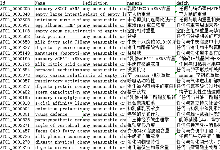
Fig. 1
Example of ontology name and definition translation results"

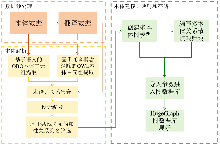
Fig. 2
Agricultural multi-ontology analysis and import process based on graph database"
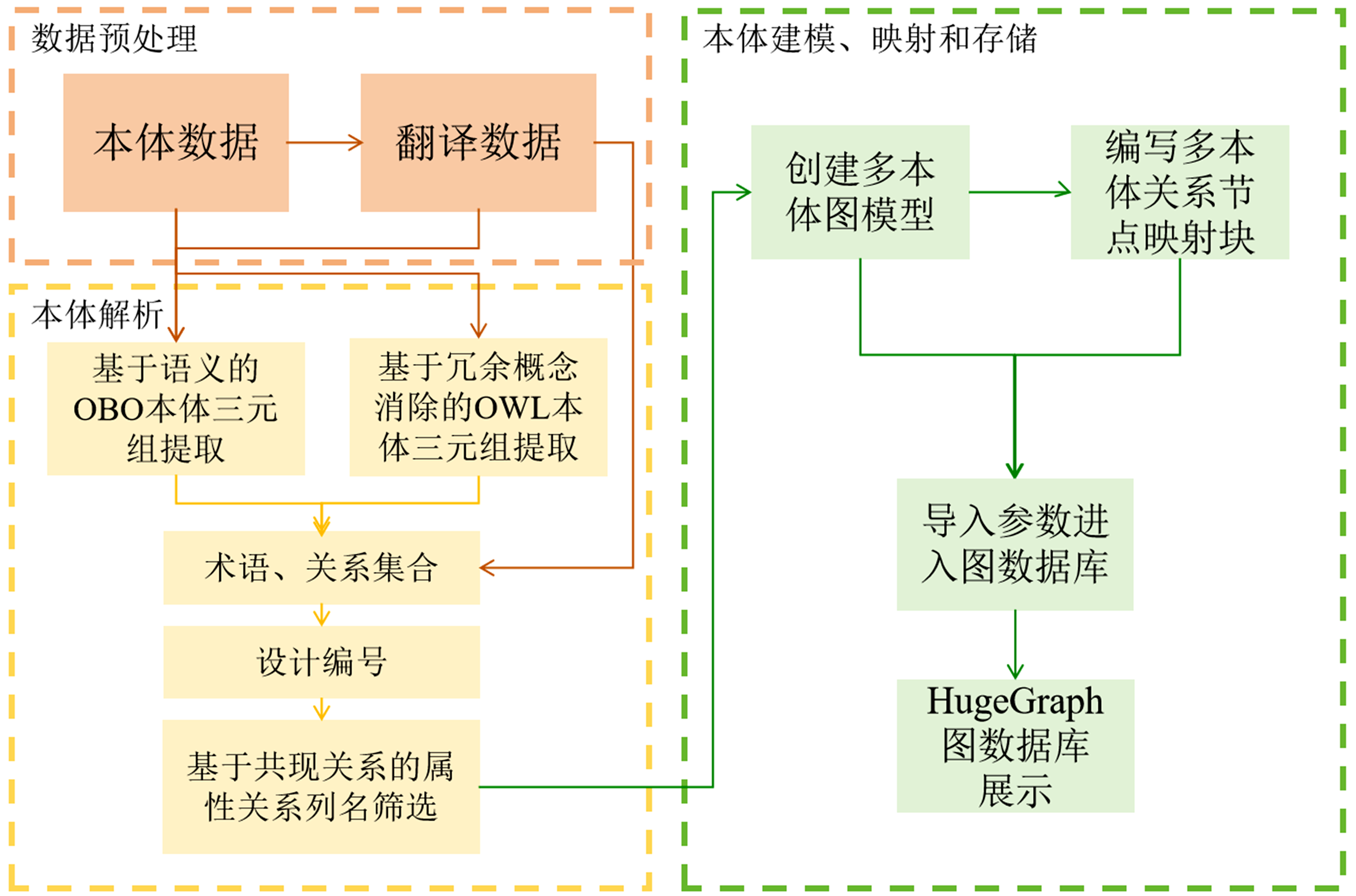
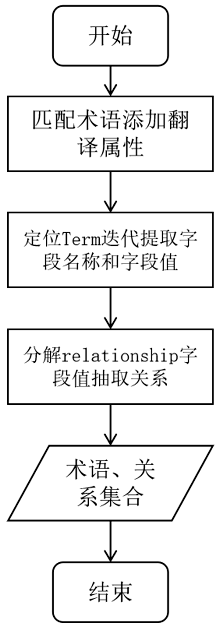
Fig. 3
Flowchart of semantic-based OBO ontology processing"
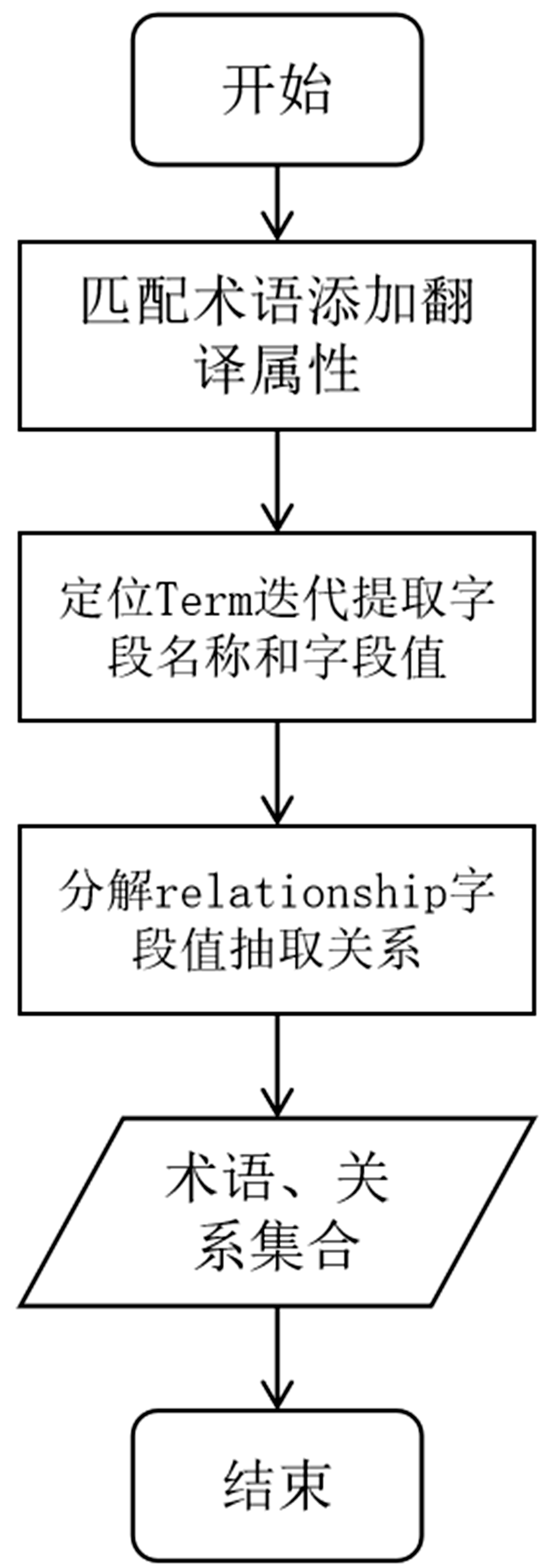
Table 2
Example of OBO ontology file content and format conversion results"
| OBO格式本体文本内容 | 格式转换结果 | ||
|---|---|---|---|
| [Term] id: GO:0000070 name: mitotic sister chromatid segregation namespace: biological_process alt_id: GO:0016359 def: "The cell cycle process in which replicated homologous chromosomes are organized and then physically separated and apportioned to two sets during the mitotic cell cycle. Each replicated chromosome, composed of two sister chromatids, aligns at the cell equator, paired with its homologous partner. One homolog of each morphologic type goes into each of the resulting chromosome sets." [GOC:ai, GOC:jl] subset: goslim_pombe synonym: "mitotic chromosome segregation" EXACT [] synonym: "mitotic sister-chromatid adhesion release" NARROW [] is_a: GO:0000819 ! sister chromatid segregation is_a: GO:1903047 ! mitotic cell cycle process intersection_of: GO:0098813 ! nuclear chromosome segregation intersection_of: part_of GO:0140014 ! mitotic nuclear division relationship: part_of GO:0140014 ! mitotic nuclear division namezh: 有丝分裂姐妹染色单体分离 defzh: 该细胞周期过程在有丝分裂细胞周期中对复制的同源染色体进行组织并随后物理分离和分配到两组。每个复制的染色体由两条姐妹染色单体组成,它们在细胞赤道处对齐,与同源配对伙伴配对。每种形态类型的同源染色体中的一个进入产生的染色体组中的一个。 | Subject | Predicate | Object |
| GO:0000070 | name | mitotic sister chromatid segregation | |
| GO:0000070 | namespace | biological_process | |
| GO:0000070 | alt_id | GO:0016359 | |
| GO:0000070 | def | "The cell cycle process in which replicated homologous chromosomes are organized and then physically separated and apportioned to two sets during the mitotic cell cycle. Each replicated chromosome, composed of two sister chromatids, aligns at the cell equator, paired with its homologous partner. One homolog of each morphologic type goes into each of the resulting chromosome sets." [GOC:ai, GOC:jl] | |
| GO:0000070 | subset | goslim_pombe | |
| GO:0000070 | synonym | "mitotic sister-chromatid adhesion release" NARROW [] | |
| GO:0000070 | is_a | GO:1903047 | |
| GO:0000070 | intersection_of | part_of GO:0140014 | |
| GO:0000070 | part_of | GO:0140014 | |
| GO:0000070 | namezh | 有丝分裂姐妹染色单体分离 | |
| GO:0000070 | defzh | 该细胞周期过程在有丝分裂细胞周期中对复制的同源染色体进行组织并随后物理分离和分配到两组。每个复制的染色体由两条姐妹染色单体组成,它们在细胞赤道处对齐,与同源配对伙伴配对。每种形态类型的同源染色体中的一个进入产生的染色体组中的一个。 | |
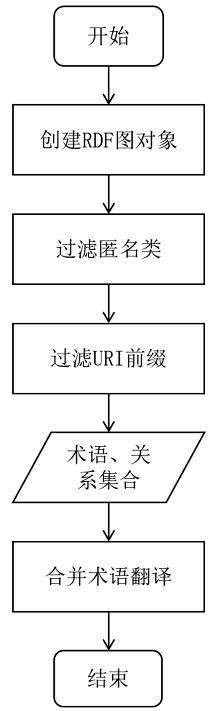
Fig. 4
Flowchart of OWL ontology processing based on redundancy concept elimination"

Table 3
Example of OWL ontology file content and format conversion results"
| OWL格式本体文本内容 | 格式转换结果 | ||
|---|---|---|---|
| <!-- <owl:Class rdf:about="&obo;FOODON_00003552"> <rdfs:subClassOf rdf:resource="&obo;FOODON_00003458"/> <obo:IAO_0000115 xml:lang="en">A white-colored spear of a white asparagus plant which grows underground, without chlorophyll.</obo:IAO_0000115> <obo:IAO_0000117 rdf:resource="http://orcid.org/0000-0002-8844-9165"/> <dcterms:contributor> <dcterms:date rdf:datatype="&xsd;dateTime">2020-10-21T05:37:26</dcterms:date> <oboInOwl:hasExactSynonym xml:lang="en">edible ivory</oboInOwl:hasExactSynonym> <oboInOwl:hasExactSynonym xml:lang="en">royal vegetable</oboInOwl:hasExactSynonym> <oboInOwl:hasExactSynonym xml:lang="en">white asparagus</oboInOwl:hasExactSynonym> <oboInOwl:hasExactSynonym xml:lang="en">white gold asparagus</oboInOwl:hasExactSynonym> <rdfs:label xml:lang="en">white asparagus spear</rdfs:label> </owl:Class> | Subject | Predicate | Object |
| FOODON_00003552 | type | Class | |
| FOODON_00003552 | subClassOf | FOODON_00003458 | |
| FOODON_00003552 | definition | A white-colored spear of a white asparagus plant which grows underground, without chlorophyll. | |
| FOODON_00003552 | term editor | 0000-0002-8844-9165 | |
| FOODON_00003552 | contributor | 0000-0001-5275-8866 | |
| FOODON_00003552 | date | 2020-10-21T05:37:26 | |
| FOODON_00003552 | hasExactSynonym | edible ivory | |
| FOODON_00003552 | hasExactSynonym | royal vegetable | |
| FOODON_00003552 | hasExactSynonym | white asparagus | |
| FOODON_00003552 | hasExactSynonym | white gold asparagus | |
| FOODON_00003552 | label | white asparagus spear | |
Table 4
List of reserved attribute names for each ontology"
| 属性名称 | 数据类型 | 说明 |
|---|---|---|
| Vertex_ID | Int | 术语编号 |
| ontology_id | Text | 原始编码 |
| name | Text | 术语名称 |
| subset | Text | 子集 |
| is_obsolete | Text | 是否过时 |
| def | Text | 定义 |
| synonym | Text | 同义词 |
| xref | Text | 外部参照 |
| comment | Text | 注释 |
| alt_id | Text | 可替代术语(可跨本体) |
| created_by | Text | 创建作者 |
| creation_date | Text | 创建日期 |
| consider | Text | 可参考术语 |
| replaced_by | Text | 被术语替代 |
| namespace | Text | 命名空间 |
| namezh | Text | 中文名称 |
| defzh | Text | 中文定义 |
| property_value | Text | 属性值 |
| disjoint_from | Text | 完全不重叠术语 |
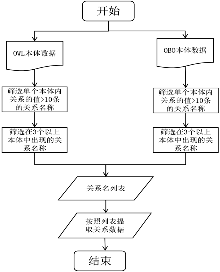
Fig. 5
Relationship screening flowchart"

Table 5
List of relationship names for each ontology"
| 关系名称 | 说明 | 描述 |
|---|---|---|
| is_a | 继承关系 | 表示一种具体概念是另一种概念的子类。 |
| part_of | 部分整体关系 | 表示一个概念是另一个概念的一部分。 |
| has_part | 部分整体逆向关系 | 表示一个概念拥有某个部分。 |
| has_quality | 属性关系 | 表示一个概念拥有某种性质或特性。 |
| intersection_of | 交集关系 | 表示某个概念是两个概念的交集。 |
| occurs_in | 时空关系 | 表示一个概念在特定时间和空间中发生,表示某个事件、过程或行为发生在某个特定的环境、位置或范围中。 |
| negatively_regulates | 负调节关系 | 表示一个概念对另一个概念的调节作用是负向的,即减少或抑制某种活动或过程。 |
| only_in_taxon | 约束关系 | 表示某个概念仅适用于特定的物种或类群。 |
| positively_regulates | 正调节关系 | 表示一个概念对另一个概念的调节作用是正向的,即促进或增强某种活动或过程。 |
| regulates | 调节关系 | 表示某个概念对另一个概念的调节作用,通常不指定是正向还是负向调节。 |
| disjointWith | 不相交关系 | 表示两个概念在本体中是完全互不相交的,即它们没有任何共享的实例。 |
| subClassOf | 继承关系 | 表示一个概念是另一个概念的子类,表示继承、包含或特性传递。 |
| determined_by | 因果关系 | 表示某个概念是由其他概念所决定或确定的。 |
| develops_from | 演变关系 | 表示某个概念是从另一个概念演变、发展或衍生出来的。 |
Table 6
Example of diagram model file contents"
| 创建内容 | 示例 |
|---|---|
| 创建属性 | schema.propertyKey("Vertex_ID").asInt().ifNotExist().create(); |
| 创建顶点类型 | schema.vertexLabel("aeo") .properties("Vertex_ID", "ontology_id", "name", "subset", "is_obsolete", "def", "synonym", "xref", "comment", "alt_id", "created_by", "creation_date", "consider", "replaced_by", "namespace", "namezh", "defzh", "property_value", "disjoint_from") .primaryKeys("Vertex_ID") .ifNotExist() .create(); |
| 创建索引 | schema.indexLabel("aeoByontology_id") .onV("aeo") .by("ontology_id") .secondary() .ifNotExist() .create(); |
| 创建边类型 | schema.edgeLabel("aeo_has_part") .sourceLabel("aeo") .targetLabel("aeo") .ifNotExist() .create(); |
Table 7
Examples of vertex and edge mapping block formats"
| 映射类型 | 映射块格式示例 |
|---|---|
| 顶点 | "vertices": [ { "label": "aeo", "input": { "type": "file", "path": " aeo_dian.csv的路径", "format": "CSV", "header": ["Vertex_ID", "ontology_id", "name", "subset", "is_obsolete", "def", "synonym", "xref", "comment", "alt_id", "created_by", "creation_date", "consider", "replaced_by", "namespace", "namezh", "defzh", "property_value", "disjoint_from"], "charset": "UTF-8", "skipped_line": { "regex": "(^#|^//).*" } } } |
| 边 | "edges": [ { "label": "aeo_has_part", "source": [ "source_name" ], "target": [ "target_name" ], "input": { "type": "file", "path": "aeo_has_part.csv的路径", "format": "CSV" }, "field_mapping": { "source_name": "Vertex_ID", "target_name": "Vertex_ID" } } |
Table 8
Example of diagram model file contents"
| 本体名称 | 实体数量(个) | 本体内关系数量(条) |
|---|---|---|
| aeo | 250 | 366 |
| agro | 2768 | 3118 |
| assfo | 252 | 247 |
| atol | 2172 | 2216 |
| cdno | 2059 | 2241 |
| chebi | 3051 | 3521 |
| cl | 15964 | 60879 |
| ecocore | 5047 | 17508 |
| EDAM | 2745 | 3045 |
| envo | 3247 | 1846 |
| eol | 624 | 635 |
| flopo | 24204 | 346 |
| foodon | 10970 | 7765 |
| go | 9166 | 9187 |
| lbo | 1113 | 1108 |
| lpt | 503 | 562 |
| OBIws | 130 | 61 |
| omo | 27 | 26 |
| pato | 1858 | 2121 |
| peco | 2552 | 3378 |
| po | 1705 | 2619 |
| pro | 67906 | 38283 |
| pso | 419 | 794 |
| ro | 53 | 49 |
| seont | 1217 | 1869 |
| sfwo | 368 | 493 |
| so | 2597 | 3445 |
| to | 4920 | 6184 |
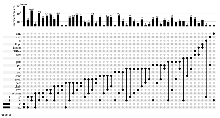
Fig. 6
Upset plot of the number of relationships between ontologies"

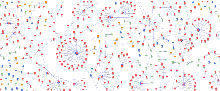
Fig. 7
Localized map of query results for agricultural multi-ontology data nodes"

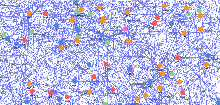
Fig. 8
Localized map of agricultural multi-ontology data relationship query results"

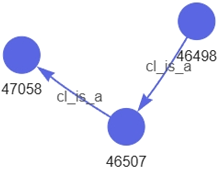
Fig. 9
All relationship query results for CL:0000010 term Number 46507"

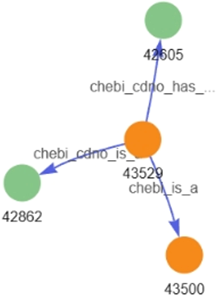
Fig. 10
All relationship query results for CHEBI:30961 term Number 43529"

| [1] | 陈宝发, 任妮. 面向农业学者领域的本体构建及可视化研究. 江苏农业科学, 2023, 51(18): 191-200. DOI:10.15889/j.issn.1002-1302.2023.18.028. |
| CHEN B F, REN N. Ontology construction and visualization in the field of agricultural scholars. Jiangsu Agricultural Sciences, 2023, 51(18): 191-200. DOI:10.15889/j.issn.1002-1302.2023.18.028. | |
| [2] |
GOLDSTEIN A, FINK L, RAVID G. A framework for evaluating agricultural ontologies. Sustainability, 2021, 13(11): 6387.
doi: 10.3390/su13116387 |
| [3] | ZHENG Y L, HE Q Y, QIAN P, LI Z. Construction of the ontology-based agricultural knowledge management system. Journal of Integrative Agriculture, 2012, 11(5): 700-709. DOI:10.1016/S2095-3119(12)60059-8. |
| [4] | FONOU-DOMBEU J V, NAIDOO N, RAMNANAN M, et al. OntoCSA: A climate-smart agriculture ontology. International Journal of Agricultural and Environmental Information Systems (IJAEIS), 2021, 12(4): 1-20. |
| [5] | 徐勇, 安祥生, 王志强. 基于农业资源分类的农业资源本体架构设计. 农业网络信息, 2009 (10): 8-12+27. |
| XU Y, AN X S, WANG Z Q. Design of agricultural resource ontology architecture based on agricultural resource classification. Agriculture Network Information, 2009(10): 8-12+27. | |
| [6] | 张善庄, 刘怀亮, 赵舰波, 等. 领域顶层本体研究:模型与构建方法. 情报杂志, 2024, 43(7): 112-121. |
| ZHANG S Z, LIU H L, ZHAO J B, et al. Research on domain upper ontology: Model and construction method. Journal of Intelligence, 2024, 43(7): 112-121. | |
| [7] | 苏玉宁, 姜艺, 陈贺胜, 等. 基于Ontology的农业科学领域知识库构建. 江苏农业科学, 2018, 46(5): 194-198. DOI:10.15889/j.issn.1002-1302.2018.05.052. |
| SU Y N, JIANG Y, CHEN H S, et al. Construction of knowledge base in agricultural science field based on ontology. Jiangsu Agricultural Sciences, 2018, 46(5): 194-198. DOI:10.15889/j.issn.1002-1302.2018.05.052. | |
| [8] | 黄奇, 钱韵洁, 袁勤俭, 等. 基于图形数据库的OWL本体存储模型研究. 情报学报, 2019, 38(3): 310-321. |
| HUANG Q, QIAN Y J, YUAN Q J, et al. Research on OWL ontology storage model based on graph database. Journal of the China Society for Scientific and Technical Information, 2019, 38(3): 310-321. | |
| [9] | 侯琛, 牛培宇. 农业知识图谱技术研究现状与展望. 农业机械学报, 2024, 55(6): 1-17. |
|
HOU C, NIU P Y. Research status and prospect of agricultural knowledge graph technology. Transactions of the Chinese Society for Agricultural Machinery, 2024, 55(6): 1-17.
doi: 10.62321/issn.1000-1298 |
|
| [10] | 张慧, 侯霞, 李宁. 本体存储方法研究. 北京信息科技大学学报(自然科学版), 2016, 31(3): 59-63. |
| ZHANG H, HOU X, LI N. A survey of research on ontology storage methods. Journal of Beijing Information Science & Technology University (Natural Science Edition), 2016, 31(3): 59-63. | |
| [11] | QI C L, SONG Q, ZHANG P Z, YUAN H. Cn-MAKG: China Meteorology and Agriculture Knowledge Graph Construction Based on Semi-Structured Data// In 2018 IEEE/ACIS 17th International Conference on Computer and Information Science (ICIS). IEEE, 2018: 692-696. DOI: 10.1109/ICIS.2018.8466485. |
| [12] | SHI Y X, ZHANG B K, WANG Y X, et al. Constructing crop portraits based on graph databases is essential to agricultural data mining. Information, 2021, 12(6): 227. DOI:10.3390/info12060227. |
| [13] |
AYDIN S, AYDIN M N. Ontology-based data acquisition model development for agricultural open data platforms and implementation of OWL2MVC tool. Computers and Electronics in Agriculture, 2020, 175: 105589.
doi: 10.1016/j.compag.2020.105589 |
| [14] | POKORNÝ J. Graph Databases: Their Power and Limitations// IFIP International Conference on Computer Information Systems and Industrial Management. Springer International Publishing, Cham, 2015: 58-69. |
| [15] | LOPEZ-VEYNA J I, CASTILLO-ZUÑIGA I, ORTIZ-GARCIA M. A Review of Graph Databases // International Conference on Software Process Improvement. Springer International Publishing, Cham, 2022: 180-195. |
| [16] | BHATTACHARYYA A, CHAKRAVARTY D. Graph Database: A Survey // 2020 International Conference on Computer, Electrical & Communication Engineering (ICCECE). IEEE, 2020: 1-8. |
| [17] | ANGLES R. A Comparison of Current Graph Database Models // 2012 IEEE 28th International Conference on Data Engineering Workshops. IEEE, 2012: 171-177. |
| [18] |
RUBIN D L, NOY N F, MUSEN M A. Protégé: A tool for managing and using terminology in radiology applications. Journal of Digital Imaging, 2007, 20(Suppl 1): 34-46.
doi: 10.1007/s10278-007-9065-0 |
| No related articles found! |
|
||