
Journal of Agricultural Big Data ›› 2026, Vol. 8 ›› Issue (3): 354-372.doi: 10.19788/j.issn.2096-6369.000168
Previous Articles Next Articles
XIE NengFu1,2,3( ), WANG XiaoLi1,2,3,*(), WANG Xin1,2,3,*(), MENG ZhiBo1,2,3, MAN Rui1,2,3, ZHAO ZhongHe1,2,3, WU Hao1,2,3, LV QianJie1,2,3
Received:2026-07-20
Accepted:2024-09-15
Online:2026-09-26
Published:2026-10-08
Contact:
WANG XiaoLi, WANG Xin
XIE NengFu, WANG XiaoLi, WANG Xin, MENG ZhiBo, MAN Rui, ZHAO ZhongHe, WU Hao, LV QianJie. Agricultural High-Quality Dataset Evaluation Framework and Full- Lifecycle Governance Pathway[J].Journal of Agricultural Big Data, 2026, 8(3): 354-372.
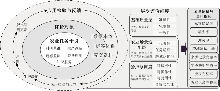
Fig. 1
A hierarchical framework for evaluating high-quality agricultural datasets"
Table 1
A hierarchical evaluation indicator system for high-quality agricultural datasets: quality evidence, quantitative indicators, and metrics"
| 层级 | 评价维度 | 核心问题 | 质量证据 | 可量化指标与度量方法 | 短板指向 |
|---|---|---|---|---|---|
| 基础质量层 | 准确性 | 观测值和标签是否可靠 | 专家复核记录、地面调查结果、传感器校准说明 | 标签错误率=错误标签数/抽检样本数;专家一致率;传感器校准误差 | 干扰模型训练和评测 |
| 基础质量层 | 完整性 | 字段、样本和元数据是否充分 | 元数据清单、字段字典、缺失值处理记录 | 字段缺失率=缺失字段数/应填字段数;样本缺失率;元数据完备率 | 削弱复现和复用价值 |
| 基础质量层 | 一致性 | 空间、时间、语义和格式是否统一 | 坐标系统说明、类别字典、标注边界规则 | 格式冲突率;类别冲突率;坐标/单位一致率;模式冲突率 | 增加数据融合成本 |
| 农业场景适配层 | 代表性 | 样本是否覆盖真实农业差异 | 分层样本清单、跨区域划分、长尾样本说明 | 区域覆盖率;季节覆盖率;生育期覆盖率;长尾类别覆盖率;分布散度 | 造成跨场景泛化不足 |
| 农业场景适配层 | 任务适配性 | 是否匹配具体农业任务 | 任务说明书、标签体系说明、评测任务定义 | 任务标签匹配率;关键场景覆盖率;任务边界完整率 | 导致任务定义泛化 |
| 农业场景适配层 | 跨域泛化性 | 是否支持跨区域、跨年份、跨设备应用 | 跨域测试集、独立验证集、外部评测结果 | 跨域性能下降率=域内性能−域外性能;跨区域测试精度;跨年份测试精度 | 生产场景应用失效 |
| 治理复用层 | 可追溯性 | 数据来源和处理过程是否可审计 | 来源记录、处理流程、版本日志 | 来源记录完整率;处理流程记录率;版本记录完整率 | 降低数据可信度 |
| 治理复用层 | 互操作性 | 是否支持跨平台和多源融合 | 机器可读元数据、标准格式、字段映射表 | 字段映射完成率;标准格式覆盖率;机器可读元数据覆盖率 | 限制跨平台融合 |
| 治理复用层 | 可复用性 | 是否便于再次使用和复现实验 | DOI、数据论文、基准划分、样例代码 | 文档完备率;样例代码可运行率;基准复现率 | 难以支撑长期研究 |
| 治理复用层 | 合规安全 | 是否具备开放边界和安全控制 | 脱敏规则、授权记录、用途限制说明 | 脱敏覆盖率;授权完整率;访问控制记录完整率;用途限制说明完备率 | 阻碍安全开放共享 |
Table 2
Weighting priorities in quality evaluation across different agricultural tasks"
| 农业任务 | 基础质量层 | 农业场景适配层 | 治理复用层 | 权重侧重说明 |
|---|---|---|---|---|
| 遥感作物分类与估产 | 0.30 | 0.45 | 0.25 | 更重视跨区域、跨年份、时序完整性、地面真值一致性和空间代表性 |
| 病虫害识别 | 0.40 | 0.40 | 0.20 | 更重视标签准确性、病害阶段覆盖、田间复杂背景和长尾类别样本 |
| 畜牧多模态监测 | 0.35 | 0.35 | 0.30 | 更重视传感器校准、模态配准、个体追踪、连续记录和隐私合规 |
| 农业文本知识与问答 | 0.35 | 0.30 | 0.35 | 更重视术语一致性、来源可信度、语义对齐、可追溯性和开放复用 |
Table 3
Key technical aspects of ai-ready data structures in agriculture"
| 技术环节 | 主要问题 | 表达机制 |
|---|---|---|
| 时序动态对齐 | 遥感、气象、土壤和农事记录时间粒度不一致 | 地块ID、时间窗口、生育期标签 |
| 多源异构融合 | 图像、遥感、传感器和文本数据格式差异大 | 跨模态样本ID、统一数据字典 |
| 语义嵌入表示 | 作物、病虫害、生育期等概念不统一 | 农业本体、知识图谱、标准术语表 |
| 指令微调数据 | 传统“样本—标签”结构难以支撑大模型应用 | 指令—输入—输出—证据—约束 |
| 知识/语义对齐 | 大模型回答易脱离农业专业知识和应用语境 | 知识图谱、RAG检索、证据来源标注 |
| 幻觉抑制与审核 | 农技建议、病害诊断和用药建议存在高风险 | 专家审核、风险提示、适用边界说明 |
| 模型评测适配 | 随机划分难以检验真实泛化能力 | 跨区域、跨年份、跨生育期测试集 |
Table 4
Representative agricultural dataset cases across different data modalities and their review insights"
| 数据模态 | 代表性案例 | 主要业务场景 | 主要价值 | 质量问题 |
|---|---|---|---|---|
| 视觉图像 | PlantVillage、PlantDoc | 病害识别 | 推动病害诊断模型发展 | 实验环境与田间环境迁移落差 |
| 视觉图像 | IP102、DeepWeeds | 害虫识别、杂草分类 | 凸显自然场景和长尾类别价值 | 类别不均衡、尺度变化 |
| 遥感与地理空间 | CropHarvest、Sen4AgriNet | 作物分类、遥感时序建模 | 验证多区域时序样本对泛化的意义 | 地面真值不足、域偏移突出 |
| 地块与资源环境 | EuroCrops、SoilGrids 2.0、WorldClim 2 | 地块开放数据、土壤气候建模 | 支撑跨机构复用与环境变量建模 | 类别体系、分辨率和元数据标准不统一 |
| 文本知识 | AgCNER | 农业实体识别、知识服务 | 拓展农业中文NLP数据基础 | 术语边界、实体嵌套和来源可信度 |
| 多模态感知 | 奶牛多模态、柑橘黄龙病、番茄多模态 | 畜牧监测、病害诊断、果蔬 采收 | 支撑真实生产场景感知 | 模态配准、专家审核和过程追溯不足 |
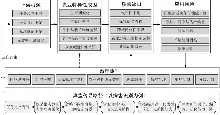
图2
Generation and transmission mechanisms of quality issues specific to agricultural data"
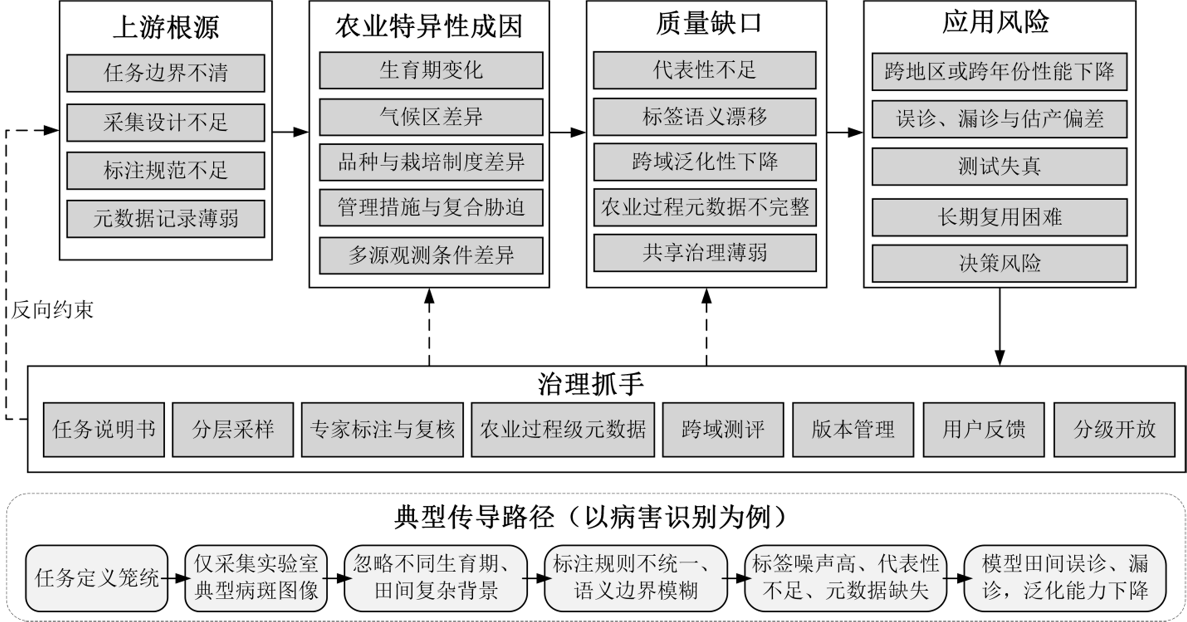
Table 5
A comparison of general data issues and agricultural data-specific quality challenges"
| 通用数据问题 | 农业特异性表现 | 深层成因 | 可能质量后果 |
|---|---|---|---|
| 需求边界不清 | 同一数据集难以同时服务病害分类、病斑分割、病害程度评估和防治决策 | 农业任务与作物生育期、管理目标、生产环节高度绑定 | 任务定义泛化,模型应用边界不清 |
| 样本代表性不足 | 样本集中于少数地区、季节、品种或理想拍摄条件 | 作物生长受气候区、栽培制度、品种和田间管理共同影响 | 跨区域、跨年份、跨生育期泛化能力下降 |
| 标签语义漂移 | 同一病害或长势标签在苗期、开花期、成熟期含义不同 | 生物生长过程导致表型连续变化,标签依赖物候阶段 | 标签边界不稳定,训练集与测试集语义不一致 |
| 域偏移 | 同一作物在不同气候区、不同种植制度下呈现不同影像或表型特征 | 气候、土壤、品种、轮作制度和管理措施共同改变数据分布 | 跨气候区、跨种植制度应用失效 |
| 标注可靠性不足 | 病虫害、作物长势、畜禽健康等标签需要专家结合症状、时期和背景判断 | 农业标签依赖植保、农学、畜牧、遥感等领域知识 | 普通标注员难以保证一致性,专家复核成本高 |
| 元数据不完整 | 缺少品种、生育期、气象条件、栽培制度、管理措施等农业上下文 | 农业数据解释高度依赖环境和管理背景 | 数据难以复用,模型误差难以解释 |
| 开放共享受限 | 农户经营数据、地块边界、养殖场视频等难以完全开放 | 涉及隐私、商业秘密、地理位置和生产安全 | 数据开放不足,长期维护和复用困难 |
Fig. 3
A framework for full-lifecycle data quality governance and reverse traceability of high-quality agricultural datasets"
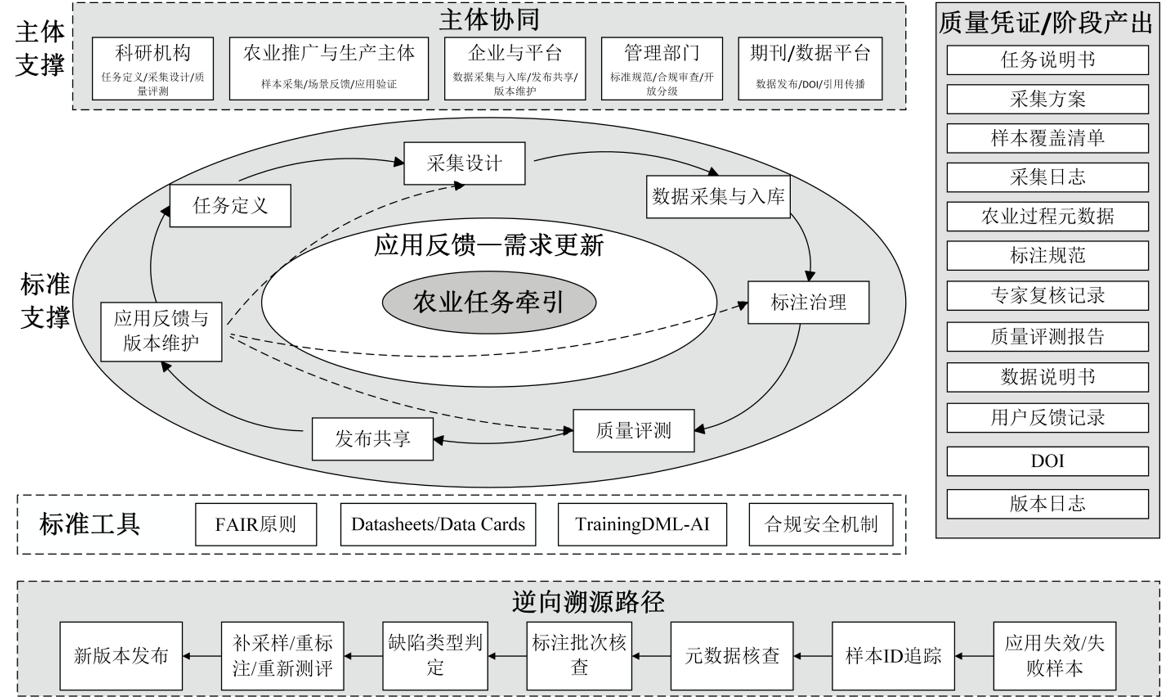
Table 6
Quality control checkpoints, quality evidence, and remediation approaches across the full lifecycle of agricultural datasets"
| 生命周期阶段 | 质量控制节点 | 质量凭证 | 修复方式 |
|---|---|---|---|
| 任务定义 | 任务目标、适用场景、评价指标和限制场景 | 任务说明书、适用边界说明 | 修订任务范围和限制场景 |
| 采集设计 | 区域、年份、生育期、品种、栽培制度和设备覆盖 | 采集方案、样本覆盖清单 | 补充缺失区域、生育期或设备条件样本 |
| 数据采集与入库 | 格式、缺失值、异常样本和元数据完整性 | 采集日志、数据字典、农业过程级元数据 | 数据清洗、异常修正、补充元数据 |
| 标注治理 | 标注规范、专家一致率、复核比例和争议样本处理 | 标注规范、专家复核记录、争议样本记录 | 修订规范、重新标注、专家仲裁 |
| 质量评测 | 准确性、完整性、代表性和跨域泛化性 | 质量评测报告、跨域评测结果 | 调整测试划分,增加跨域测试集 |
| 发布共享 | 数据说明、授权协议、脱敏处理、版本号和引用方式 | 数据说明书、授权协议、DOI、版本号 | 完善说明文档,调整共享权限 |
| 应用反馈与维护 | 用户反馈、失败样本、失效场景和版本更新 | 用户反馈记录、失败样本清单、版本日志 | 补采样本、修订标注、重新评测、发布新版本 |
Table 7
Open-sharing types, governance priorities, and representative scenarios for agricultural datasets"
| 开放类型 | 适用数据 | 治理重点 | 代表场景 |
|---|---|---|---|
| 完全开放 | 低敏科研数据 | 可下载、可引用、可复现 | 公开病虫害图像、通用气候土壤数据 |
| 脱敏开放 | 生产过程数据 | 兼顾复用价值与主体权益 | 农机作业记录、地块管理记录 |
| 授权访问 | 高敏空间或经营数据 | 控制用途、权限和再分发边界 | 高精度地块边界、农户经营数据 |
| 持续服务 | 动态数据产品 | 维护版本、质量置信和反馈机制 | 作物制图产品、农业资源环境数据产品 |
| [1] |
Wolfert S, Ge L, Verdouw C, et al. Big data in smart farming-a review. Agricultural Systems, 2017, 153: 69-80.
doi: 10.1016/j.agsy.2017.01.023 |
| [2] |
Liakos K G, Busato P, Moshou D, et al. Machine learning in agriculture: A review. Sensors, 2018, 18(8): 2674.
doi: 10.3390/s18082674 |
| [3] |
Basso B, Antle J. Digital agriculture to design sustainable agricultural systems. Nature Sustainability, 2020, 3(4): 254-256.
doi: 10.1038/s41893-020-0510-0 |
| [4] |
中国农业科学院农业信息研究所. 农业大数据研究进展(2024). 农业大数据学报, 2024, 6(4): 433-468.
doi: 10.19788/j.issn.2096-6369.200003 |
|
Agricultural Information Institute of CAAS. Progress of agricultural big data research (2024). Journal of Agricultural Big Data, 2024, 6(4): 433-468.
doi: 10.19788/j.issn.2096-6369.200003 |
|
| [5] |
Chamorro-Padial J, García R, Gil R. A systematic review of open data in agriculture. Computers and Electronics in Agriculture, 2024, 219: 108775.
doi: 10.1016/j.compag.2024.108775 |
| [6] |
Whang S E, Roh Y, Song H, et al. Data collection and quality challenges in deep learning: a data-centric AI perspective. The VLDB Journal, 2023, 32:791-813. https://doi.org/10.1007/s00778-022-00775-9.(arXiv:2112.06409)
doi: 10.1007/s00778-022-00775-9 |
| [7] |
Paullada A, Raji I D, Bender E M, et al. Data and its (dis) contents: A survey of dataset development and use in machine learning research. Patterns, 2021, 2(11): 100336.
doi: 10.1016/j.patter.2021.100336 |
| [8] | 管博伦, 张立平, 朱静波, 等. 农业病虫害图像数据集构建关键问题及评价方法综述. 智慧农业(中英文), 2023, 5(3): 17-34. |
|
GUAN B L, ZHANG L P, ZHU J B, et al. The key issues and evaluation methods for constructing agricultural pest and disease image datasets: A review. Smart Agriculture, 2023, 5(3): 17-34.
doi: 10.12133/j.smartag.SA202306012 |
|
| [9] |
姚艳敏, 白玉琪. 农业大数据标准体系框架研究. 农业大数据学报, 2019, 1(4): 76-85.
doi: 10.19788/j.issn.2096-6369.190408 |
|
Yao Y M, Bai Y Q. A Framework for agricultural big data standards. Journal of Agricultural Big Data, 2019, 1(4):76-85.
doi: 10.19788/j.issn.2096-6369.190408 |
|
| [10] | Wang R Y, Strong D M. Beyond accuracy: What data quality means to data consumers. Journal of Management Information Systems, 1996, 12(4): 5-33. |
| [11] | Batini C, Cappiello C, Francalanci C, et al. Methodologies for data quality assessment and improvement. ACM Computing Surveys (CSUR), 2009, 41(3): 1-52. |
| [12] |
Cai L, Zhu Y Y. The challenges of data quality and data quality assessment in the big data era. Data Science Journal, 2015, 14: 2.
doi: 10.5334/dsj-2015-002 |
| [13] | Strong D M, Lee Y W, Wang R Y. Data quality in context. Communications of the ACM, 1997, 40(5): 103-110. |
| [14] | Wang R Y. A product perspective on total data quality management. Communications of the ACM, 1998, 41(2): 58-65. |
| [15] |
Lee Y W, Strong D M, Kahn B K, et al. AIMQ: A methodology for information quality assessment. Information & Management, 2002, 40(2): 133-146.
doi: 10.1016/S0378-7206(02)00043-5 |
| [16] | Saaty T L. The Analytic Hierarchy Process[M]. New York: McGraw- Hill, 1980. |
| [17] | Wilkinson M D, Dumontier M, Aalbersberg I J, et al. The FAIR Guiding Principles for scientific data management and stewardship. Scientific Data, 2016, 3(1): 1-9. |
| [18] |
Ali B, Dahlhaus P. The role of FAIR data towards sustainable agricultural performance: a systematic literature review. Agriculture, 2022, 12(2): 309.
doi: 10.3390/agriculture12020309 |
| [19] | Gebru T, Morgenstern J, Vecchione B, et al. Datasheets for datasets. Communications of the ACM, 2021, 64(12): 86-92. |
| [20] | Pushkarna M, Zaldivar A, Kjartansson O. Data cards: Purposeful and transparent dataset documentation for responsible Ai[C]// Proceedings of the 2022 ACM Conference on Fairness, Accountability, and Transparency. 2022: 1776-1826. |
| [21] | Yue P, Shangguan B, Ziebelin D. The OGC training data markup language for artificial intelligence (TrainingDML-AI) standard[C]// EGU General Assembly Conference Abstracts. 2023: EGU-16998. DOI:10.5194/egusphere-egu23-16998. |
| [22] |
Cheng C, Messerschmidt L, Bravo I, et al. A general primer for data harmonization. Scientific Data, 2024, 11(1): 152.
doi: 10.1038/s41597-024-02956-3 pmid: 38297013 |
| [23] | Didwania K, Seth P, Kasliwal A, et al. AgriLLM: Harnessing transformers for farmer queries[C]// Proceedings of the Third Workshop on NLP for Positive Impact. Miami, Florida, USA. Stroudsburg, PA, USA: ACL, 2024: 179-187. |
| [24] | Yang S, Liu Z, Mayer W, et al. ShizishanGPT: An agricultural large language model integrating tools and resources[C]// Web Information Systems Engineering - WISE 2024. Lecture Notes in Computer Science, vol 15439. Springer, Singapore, 2025: 284-298. https://doi.org/10.1007/978-981-96-0573-6_21.(arXiv:2409.13537) |
| [25] | Awais M, Alharthi A H S A, Kumar A, et al. AgroGPT: Efficient agricultural vision-language model with expert tuning[C]//2025 IEEE/CVF Winter Conference on Applications of Computer Vision (WACV), Tucson, AZ, USA, 2025:5687-5696. 10.1109/WACV61041.2025.00555. (arXiv:2410.08405) |
| [26] | Hu Z Q, Wang L, Lan Y H, et al. LLM-adapters: An adapter family for parameter-efficient fine-tuning of large language models[C]// Proceedings of the 2023 Conference on Empirical Methods in Natural Language Processing. Singapore. Stroudsburg, PA, USA: ACL, 2023: 5254-5276. |
| [27] | Gao Y, Xiong Y, Gao X, et al. Retrieval-Augmented Generation for Large Language Models: A Survey[PP/OL]. 2023, arXiv:2312.10997. |
| [28] | Hughes D, Salathé M. An open access repository of images on plant health to enable the development of mobile disease diagnostics[PP/OL]. 2015, arXiv:1511.08060. |
| [29] |
Mohanty S P, Hughes D P, Salathé M. Using deep learning for image-based plant disease detection. Frontiers in Plant Science, 2016, 7: 1419.
pmid: 27713752 |
| [30] | Singh D, Jain N, Jain P, et al. PlantDoc: A dataset for visual plant disease detection[C]// Proceedings of the 7th ACM IKDD CoDS and 25th COMAD. Hyderabad India. ACM, 2020: 249-253. |
| [31] | Wu X P, Zhan C, Lai Y K, et al. IP102: A large-scale benchmark dataset for insect pest recognition[C]// 2019 IEEE/CVF Conference on Computer Vision and Pattern Recognition(CVPR). 2019: 8779-8788. DOI: 10.1109/CVPR.2019.00899. |
| [32] |
Olsen A, Konovalov D A, Philippa B, et al. DeepWeeds: A multiclass weed species image dataset for deep learning. Scientific Reports, 2019, 9(1): 2058.
doi: 10.1038/s41598-018-38343-3 pmid: 30765729 |
| [33] | David E, Madec S, Sadeghi-Tehran P, et al. Global wheat head detection (GWHD) dataset: A large and diverse dataset of high- resolution RGB-labelled images to develop and benchmark wheat head detection methods. Plant Phenomics, 2020: 3521852. |
| [34] | Chiu M T, Xu X Q, Wei Y C, et al. Agriculture-vision: A large aerial image database for agricultural pattern analysis[C]// 2020 IEEE/CVF Conference on Computer Vision and Pattern Recognition. 2020: 2825-2835. |
| [35] |
王伯元, 管志浩, 杨杨, 等. 2023年南京农业病虫害图像识别数据集. 农业大数据学报, 2023, 5(2): 91-96.
doi: 10.19788/j.issn.2096-6369.230214 |
|
Wang B Y, Guan Z H, Yang Y, et al. The agricultural pest and disease image recognition dataset in Nanjing, Jiangsu Province, in 2023. Journal of Agricultural Big Data, 2023, 5(2): 91-96.
doi: 10.19788/j.issn.2096-6369.230214 |
|
| [36] | Tseng G, Zvonkov I, Nakalembe C, et al. Cropharvest: A global dataset for crop-type classification[C]// NeurIPS Datasets and Benchmarks. Thirty-fifth Conference on Neural Information Processing Systems Datasets and Benchmarks Track (Round 2). 2021. https://api.semanticscholar.org/CorpusID:248529758. |
| [37] |
Sykas D, Sdraka M, Zografakis D, et al. A sentinel-2 multiyear, multicountry benchmark dataset for crop classification and segmentation with deep learning. IEEE Journal of Selected Topics in Applied Earth Observations and Remote Sensing, 2022, 15: 3323-3339.
doi: 10.1109/JSTARS.2022.3164771 |
| [38] |
Schneider M, Schelte T, Schmitz F, et al. EuroCrops: The largest harmonized open crop dataset across the European Union. Scientific Data, 2023, 10(1): 612.
doi: 10.1038/s41597-023-02517-0 pmid: 37696807 |
| [39] |
Poggio L, De Sousa L M, Batjes N H, et al. SoilGrids 2.0: producing soil information for the globe with quantified spatial uncertainty. Soil, 2021, 7(1): 217-240.
doi: 10.5194/soil-7-217-2021 |
| [40] |
Fick S E, Hijmans R J. WorldClim 2: new 1-km spatial resolution climate surfaces for global land areas. International Journal of Climatology, 2017, 37(12): 4302-4315.
doi: 10.1002/joc.2017.37.issue-12 |
| [41] |
Wu H, Xie N F, Wang X L, et al. Crop GraphRAG: pest and disease knowledge base Q&A system for sustainable crop protection. Frontiers in Plant Science, 2026, 16: 1696872.
doi: 10.3389/fpls.2025.1696872 |
| [42] |
Yao X C, Hao X, Liu R L, et al. AgCNER, the first large-scale Chinese named entity recognition dataset for agricultural diseases and pests. Scientific Data, 2024, 11(1): 769.
doi: 10.1038/s41597-024-03578-5 pmid: 38997427 |
| [43] | 杜林煊, 曹姗姗, 刘婷婷, 等. 奶牛个体头部多模态图像深度学习训练数据集. 中国科学数据(中英文网络版), 2025, 10(1): 11-20. |
| Du L X, Cao S S, LIU T T, et al. A dataset of deep learning training for multimodal headimagesofindividual cows. China Scientific Data, 2025, 10(1): 11-20. | |
| [44] | 池美香, 陈韶萍, 黄婷, 等. 柑橘黄龙病田间症状识别图像数据集. 中国科学数据(中英文网络版), 2025, 10(1): 52-61. |
| Chi M X, Chen S P, Huang T, et al. A dataset of field symptoms for identifying Citrus Huanglongbing. China Scientific Data, 2025, 10(1): 52-61. | |
| [45] | 张雨, 饶元, 陈文骏, 等. 不同成熟度番茄果实多模态图像数据集. 中国科学数据(中英文网络版), 2025, 10(1): 73-88. |
| Zhang Y, Rao Y, Chen W J, et al. A dataset of multimodal images of tomato fruits at different stagesof maturity. China Scientific Data, 2025, 10 (1): 73-88. | |
| [46] | Northcutt C G, Athalye A, Mueller J. Pervasive label errors in test sets destabilize machine learning benchmarks[C]//Proceedings of the Neural Information Processing Systems Track on Datasets and Benchmarks 1 (NeurIPS Datasets and Benchmarks 2021) round 1. (arXiv:2103.14749) |
| [47] |
Kindling M, Strecker D. Data quality assurance at research data repositories. Data Science Journal, 2022, 21:18.
doi: 10.5334/dsj-2022-018 |
| [48] |
Van Tricht K, Degerickx J, Gilliams S, et al. WorldCereal: a dynamic open-source system for global-scale, seasonal, and reproducible crop and irrigation mapping. Earth System Science Data, 2023, 15(12): 5491-5515.
doi: 10.5194/essd-15-5491-2023 |
| [49] | Tonmoy S M T I, Zaman S M M, Jain V, et al. A Comprehensive Survey of hallucination mitigation techniques in large language models[PP/OL]. 2024, arXiv:2401.01313. |
| [50] |
d'Andrimont R, Claverie M, Kempeneers P, et al. AI4Boundaries: an open AI-ready dataset to map field boundaries with Sentinel-2 and aerial photography. Earth System Science Data, 2023, 15(1): 317-329.
doi: 10.5194/essd-15-317-2023 |
| [51] |
Hengl T, Mendes de Jesus J, Heuvelink G B M, et al. SoilGrids250m: Global gridded soil information based on machine learning. PLoS One, 2017, 12(2): e0169748.
doi: 10.1371/journal.pone.0169748 |
| [1] | XU LinNa, HUANG Ting, ZHENG LiPing, FEI Xuan. Construction and Benchmark Evaluation of the Rehmannia Leaf Pest-induced Hole Image Dataset (RPHD) [J]. Journal of Agricultural Big Data, 2026, 8(2): 258-265. |
| [2] | LIAO FangYu, LI Jing, LONG Chun, YANG Fan, YUAN ZiMeng. Security Challenges and Countermeasures on Open Sharing of Scientific Data in the Context of Open Science [J]. Journal of Agricultural Big Data, 2024, 6(2): 146-155. |
| [3] | XU Jia, KANG Guiling, YU Linsong, ZHAO Yuyan, LIU Jingbing. Construction of Provincial Agricultural Geological Survey Information System Platform for Land Quality Evaluation [J]. Journal of Agricultural Big Data, 2023, 5(1): 116-125. |
| [4] | Yixuan Fan,Honglin Liu,Yanli Zhang,Fanxing Meng. Efficient Large Instrument and Scientific Data Sharing Platform Based on the Mobile Internet [J]. Journal of Agricultural Big Data, 2019, 1(3): 82-90. |
|
||