
农业大数据学报 ›› 2026, Vol. 8 ›› Issue (3): 347-353.doi: 10.19788/j.issn.2096-6369.000165
吴沛谦*( ), 钟裕欣
收稿日期:2026-05-15
接受日期:2026-07-15
出版日期:2026-09-26
发布日期:2026-10-08
通讯作者:
吴沛谦,E-mail:yzjwpq@163.com。基金资助:
WU PeiQian*(), ZHONG YuXin
Received:2026-05-15
Accepted:2026-07-15
Published:2026-09-26
Online:2026-10-08
摘要:
智慧农业演进中存在显著的“大农场偏见”盲区,全球 5 亿小农户在算法迭代中面临系统性边缘化风险。揭示其结构性不平等并构建包容性赋能机制,已成为数字乡村建设中亟待解决的核心命题。本文结合人机交互心理学与科学技术研究视角,系统综述 33 篇国内外核心文献,运用定性分析与逻辑建模构建“农业 AI 排除循环”框架,解构中国“大国小农”国情下数据红利集聚与排斥的深层机理。研究发现:(1)数字化转型已质变为“数据贫困”,本应作为数据生产者的小农户,在实践中被系统性地降格为数据客体;(2)中国语境下数据贫困呈现采集非标化、收益倒挂与主体性危机三大表征;(3)解构“双螺旋”错位机制,即大农场获“算法溢价”进入正向螺旋,而小农户因被视为“数据噪声”陷入负向排斥螺旋;(4)现行治理面临“算法威权”下的精英俘获与“数字悬浮”风险。由此,提出智慧农业应从“效率崇拜”转向“包容性赋能”。政策上应引入公平维度评估,探索组建村集体主导的“农民数据合作社”;技术上应基于“可信数据空间”研发适配碎片化环境的边缘侧模型。本研究为制定包容性数字乡村政策提供理论支撑,对保障小农户知识主权具有重要价值。
吴沛谦, 钟裕欣. 智慧农业时代的“数据贫困”:逻辑机制、表征及权益治理路径[J]. 农业大数据学报, 2026, 8(3): 347-353.
WU PeiQian, ZHONG YuXin. “Data Poverty” in the Era of Smart Agriculture: Logical Mechanisms, Representations, and Governance Pathways for Data Rights[J]. Journal of Agricultural Big Data, 2026, 8(3): 347-353.
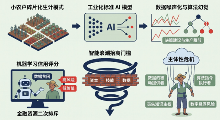
图1
智慧农业中数据要素分配的“双螺旋”错位逻辑框架"
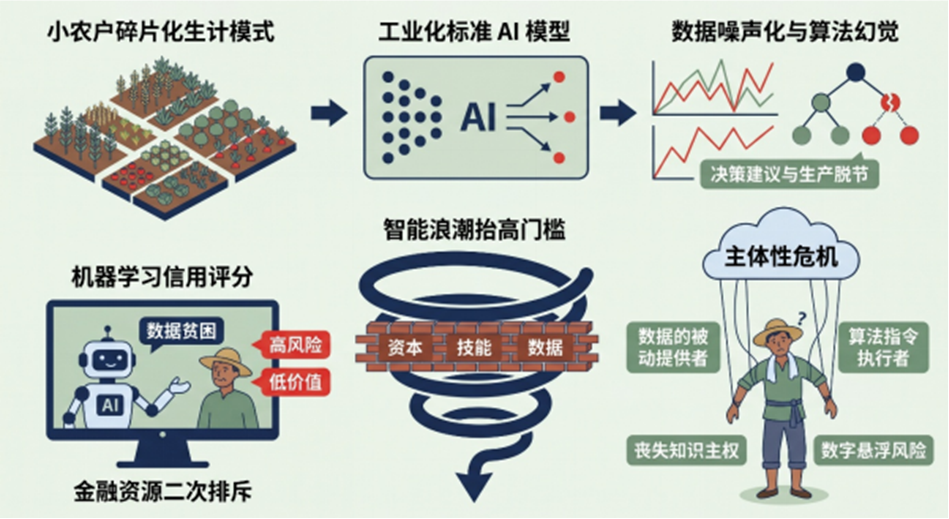
表1
智慧农业两种发展范式的特征对比"
| 评价维度 | 规模化商业AI(主导范式) | 小农户中心AI(建议范式) |
|---|---|---|
| 数据来源 | 大规模标准化单一种植数据 | 碎片化、异质性间作数据,本土知识集成 |
| 优化目标 | 绝对产量最大化,供应链效率 | 生计韧性,膳食多样性,风险抵御 |
| 用户主体性 | 自上而下自动化,“黑箱”决策执行 | 自下而上共创,“人在回路”决策增强 |
| [1] | FAO. The state of food and agriculture 2023: Revealing the true cost of food to transform agrifood systems[R]. Rome: Food and Agriculture Organization of the United Nations, 2023. |
| [2] | 杜建军, 朱尧, 张军伟. 数字经济赋能与农业智慧化:理论机理、创新模式与政策体系. 经济地理, 2026, 46(1): 193-203. |
| Du J J, Zhu Y, Zhang J W. Digital economy empowerment and agricultural intellectualization: Theoretical mechanism, innovation mode and policy system. Economic Geography, 2026, 46(1): 193-203. | |
| [3] |
吴蕾, 马晓敏, 孙巍, 等. 农业大数据研究发展(2025). 农业大数据学报, 2026, 8(1): 1-18.
doi: 10.19788/j.issn.2096-6369.200008 |
| Wu L, Ma X M, Sun W, et al. Research and development of agricultural big data (2025). Journal of Agricultural Big Data, 2026, 8(1): 1-18. | |
| [4] |
Wu P, Zhong Y. Artificial intelligence in sustainable agriculture: Towards a socio-technical roadmap. Smart Agricultural Technology, 2025, 12: 101578.
doi: 10.1016/j.atech.2025.101578 |
| [5] | 陆益龙. “数字下乡”: 数字乡村建设的经验、困境及方向. 社会科学研究, 2022(3): 126-134. |
| Lu Y L. "Digital going to the countryside": Experience, dilemma and direction of digital village construction. Social Science Research, 2022(3): 126-134. | |
| [6] | 乔榛, 张志欣. 城乡收入差距:一个基于数字鸿沟的新解释. 学术交流, 2023(8): 87-100. |
| Qiao Z, Zhang Z X. Urban-rural income gap: A new explanation based on the digital divide. Academic Exchange, 2023(8): 87-100. | |
| [7] | 蔡佳豪, 廖祖君. 农业数据产权界定与农民数据资产收益实现. 农村经济, 2026(1): 98-106. |
| Cai J H, Liao Z J. Definition of agricultural data property rights and realization of farmers' data asset returns. Rural Economy, 2026(1): 98-106. | |
| [8] | 管辉, 雷娟利. 数据要素赋能农业现代化:机理、挑战与对策. 中国流通经济, 2022, 36(6): 72-84. |
| Guan H, Lei J L. Data elements empowering agricultural modernization: Mechanism, challenges and countermeasures. China Business and Market, 2022, 36(6): 72-84. | |
| [9] |
Barba-Escoto L, van Wijk M T, López-Ridaura S. Non-linear interactions driving food security of smallholder farm households in the western Highlands of Guatemala. Frontiers in Sustainable Food Systems, 2020, 4: 51.
doi: 10.3389/fsufs.2020.00051 |
| [10] | 张晓岚. 数字经济助力乡村振兴的核心问题及对策建议. 西南金融, 2023(6): 95-106. |
| ZHANG X L. Core issues and countermeasures of digital economy boosting rural revitalization. Southwest Finance, 2023(6): 95-106. | |
| [11] | 于文静, 董峻. 全国98%以上的农业经营主体仍是小农户[EB/OL]. (2019-03-01)[2026-05-27]. |
| Yu W J, Dong J. Over 98% of agricultural business entities nationwide are still smallholder farmers[EB/OL]. (2019-03-01)[2026-05-27]. | |
| [12] | 王冬雪, 张会萍. 村集体经济组织参与小农户生产托管:优势、机制与路径. 农业经济, 2025(7): 39-41. |
| Wang D X, Zhang H P. Village collective economic organizations participating in smallholder production trusteeship: Advantages, mechanisms and paths. Agricultural Economy, 2025(7): 39-41. | |
| [13] | 许中缘, 潘笛. 关系产权视域下党建引领村集体经济组织治理研究[J/OL]. 中南大学学报(社会科学版), 2026: 1-15. |
| Xu Z Y, Pan D. Research on the governance of village collective economic organizations led by party building from the perspective of relational property rights[J/OL]. Journal of Central South University (Social Sciences), 2026: 1-15. | |
| [14] | 沈兴兴, 刘帅, 尚旭东. 农业生产性服务供求关系演变趋势与功能优化研究. 农村经济, 2021(6): 129-136. |
| Shen X X, Liu S, Shang X D. Evolution trend and function optimization of supply and demand relationship of agricultural productive services. Rural Economy, 2021(6): 129-136. | |
| [15] | 聂召英, 王伊欢. 遭遇数字风险:基层政府的治理逻辑与现实困境--以农村电商为例. 天津行政学院学报, 2023, 25(5): 3-13. |
| Nie Z Y, Wang Y H. Encountering digital risks: Governance logic and realistic dilemmas of grassroots governments-Taking rural e-commerce as an example. Journal of Tianjin Administration Institute, 2023, 25(5): 3-13. | |
| [16] | 杨发祥, 沈锦浩. 超越技术堕距:数字乡村建设何以可能?. 中州学刊, 2022(12): 106-112. |
| Yang F X, Shen J H. Beyond technological lag: How is digital village construction possible?. Zhongzhou Journal, 2022(12): 106-112. | |
| [17] | 武小龙, 曾颖. 为“注意力”而生产:乡村数字治理形式主义创造的一种新解释. 天津行政学院学报, 2026, 28(3):14-25. |
| Wu X L, Zeng Y. Production for "attention": A new explanation of formalism in rural digital governance. Journal of Tianjin Administration Institute, 2026, 28(3):14-25. | |
| [18] | 谢康, 易法敏, 古飞婷. 大数据驱动的农业数字化转型与创新. 农业经济问题, 2022(5): 37-48. |
| Xie K, Yi F M, Gu F T. Agricultural digital transformation and innovation driven by big data. Issues in Agricultural Economy, 2022(5): 37-48. | |
| [19] | Ugwu O P C, Ogenyi F C, Alum E U, et al. Implementing artificial intelligence and machine learning algorithms for optimized crop management: A systematic review on data-driven approach to enhancing resource use and agricultural sustainability. Cogent Food & Agriculture, 2025, 11(1): 2569982. |
| [20] |
毛克彪. 人工智能认知范式升级与量子遥感纪元开启. 农业大数据学报, 2026, 8(1): 19-23.
doi: 10.19788/j.issn.2096-6369.200009 |
| Mao K B. Upgrading of AI cognitive paradigm and the opening of quantum remote sensing era. Journal of Agricultural Big Data, 2026, 8(1): 19-23. | |
| [21] | 郑秋芬, 刘家成. 数据要素赋能、要素成本结构变化与小农户向大农场转型. 经济体制改革, 2024(2): 81-87. |
| Zheng Q F, Liu J C. Data element empowerment, factor cost structure change and the transition of smallholders to large farms. Reform of Economic System, 2024(2): 81-87. | |
| [22] | 鞠雷, 冯小桐. 智能浪潮对全球农业人口就业与收入分配的影响及中国金融支撑普惠性路径. 当代中国与世界, 2026(1): 76-87. |
| Ju L, Feng X T. The impact of the intelligent wave on the employment and income distribution of global agricultural population and China's financial support inclusive path. Contemporary China and the World, 2026(1): 76-87. | |
| [23] | 邓金钱, 王世宁. 公共数据开放缩小城乡收入差距了吗--来自“公共数据开放平台上线”的经验证据. 农业技术经济, 2026(2): 22-38. |
| Deng J Q, Wang S N. Has public data opening narrowed the urban-rural income gap -Empirical evidence from the "Launch of Public Data Open Platform". Journal of Agrotechnical Economics, 2026(2): 22-38. | |
| [24] | 詹晶. 小农户主动融入现代组织化经营:数字赋能与实现路径. 湖南社会科学, 2024(5): 76-82. |
| Zhan J. Smallholders actively integrating into modern organized management: Digital empowerment and realization paths. Hunan Social Sciences, 2024(5): 76-82. | |
| [25] | 纪文杰, 鞠可心, 周宏, 等. 外源触发数字乡村建设的作用机制与协同实践--基于杭州市梅林村的案例研究. 农业经济问题, 2026(1): 104-119. |
| Ji W J, Ju K X, Zhou H, et al. Mechanism and collaborative practice of exogenous triggered digital village construction-A case study of Meilin Village in Hangzhou. Issues in Agricultural Economy, 2026(1): 104-119. | |
| [26] | 王刚毅, 杜祥. 农业数据资源产权界定的经济学分析:现实困境、理论框架与制度优化. 农林经济管理学报, 2025, 24(4): 471-477. |
| Wang G Y, Du X. Economic analysis on defining property rights of agricultural data resources: Realistic dilemma, theoretical framework and institutional optimization. Journal of Agro-Forestry Economics and Management, 2025, 24(4): 471-477. | |
| [27] | 曹玉珊, 徐野. 参与收入分配视角下的数据要素核算问题研究. 财务与会计, 2024(15): 43-46. |
| Cao Y S, Xu Y. Research on the accounting of data elements from the perspective of participating in income distribution. Finance and Accounting, 2024(15): 43-46. | |
| [28] | 苏岚岚. 数字治理促进乡村治理效能提升:关键挑战、逻辑框架和政策优化. 农业经济问题, 2024(6): 58-75. |
| Su L L. Digital governance promoting the improvement of rural governance efficiency: Key challenges, logical framework and policy optimization. Issues in Agricultural Economy, 2024(6): 58-75. | |
| [29] | 李建军, 白鹏飞. 我国智慧农业创新实践的现实挑战与应对策略. 科学管理研究, 2023, 41(2): 127-134. |
| Li J J, Bai P F. Realistic challenges and coping strategies of smart agriculture innovation practice in China. Scientific Management Research, 2023, 41(2): 127-134. | |
| [30] | 尚宏利, 强国令. 基于可信数据空间的领域数据资产治理研究. 图书与情报, 2026(2): 133-144. |
| Shang H L, Qiang G L. Research on domain data asset governance based on trusted data space. Journal of Library and Information Science, 2026(2): 133-144. | |
| [31] | 亓子青, 邱俊柯, 王刚, 等. 包容性发展下小农户衔接农业生产数字化的实践模式--基于东部地区案例分析. 中国农机化学报, 2026, 47(2): 322-328. |
| Qi Z Q, Qiu J K, Wang G, et al. Practical mode of smallholders connecting agricultural production digitalization under inclusive development-Based on case analysis in eastern region. Journal of Chinese Agricultural Mechanization, 2026, 47(2): 322-328. | |
| [32] | 郑阳阳, 刘瑞峰. 农业数字化转型:内在机理、潜在风险与应对机制--基于浙江YN公司的“三位一体”共营制实践. 湖南农业大学学报(社会科学版), 2025, 26(1): 13-23. |
| Zheng Y Y, Liu R F. Agricultural digital transformation: Internal mechanism, potential risks and coping mechanisms-Based on the "Trinity" co-management practice of Zhejiang YN Company. Journal of Hunan Agricultural University (Social Sciences), 2025, 26(1): 13-23. | |
| [33] | 罗千峰, 赵奇锋, 胡雯. 智慧农业的增效机制与包容性发展路径. 中国流通经济, 2023, 37(9): 3-10. |
| Luo Q F, Zhao Q F, HU W. Efficiency enhancement mechanism and inclusive development path of smart agriculture. China Business and Market, 2023, 37(9): 3-10. |
| [1] | 曹佩佩, 李贺, 任保见. 基于多阶特征聚合的小样本虫害检测[J]. 农业大数据学报, 2026, 8(3): 296-304. |
| [2] | 刘鹏, 陈日东. 智慧农业背景下农业数据法律制度研究[J]. 农业大数据学报, 2026, 8(2): 235-244. |
| [3] | 柏晓娜, 黄文倩, 李绍稳. 农业可信数据空间构建与建议[J]. 农业大数据学报, 2026, 8(2): 212-223. |
| [4] | 哈晓琳, 李杰, 原育慧, 张子怡, 梁敏燕. 农业农村数据融合服务平台的设计与应用实践[J]. 农业大数据学报, 2025, 7(4): 468-484. |
| [5] | 孔繁涛, 赵仁杰, 张鑫蕊, 刘振虎, 曹姗姗. 推动现代农业转型:智慧农业发展的思考与展望[J]. 农业大数据学报, 2025, 7(2): 155-160. |
| [6] | 王小兵, 刘洋, 梁栋, 康婷, 康春鹏, 殷瑞锋, 陈莎, 任瑜珏, 许阳. 强力推进智慧农业建设 加快形成农业新质生产力[J]. 农业大数据学报, 2024, 6(4): 469-475. |
| [7] | 吴云坤, 杨莹, 李豪, 熊健, 陈湘灵. 智慧农业领域大数据安全问题探索[J]. 农业大数据学报, 2024, 6(3): 380-391. |
| [8] | 申其辉. 数据要素化视角下新时期国家科学数据汇交回顾与建议[J]. 农业大数据学报, 2024, 6(3): 363-372. |
| [9] | 魏若璇. 数字乡村发展中的数据安全问题研究[J]. 农业大数据学报, 2022, 4(3): 109-115. |
| [10] | 王小兵, 马晔. 我国农业农村信息化发展水平评价研究[J]. 农业大数据学报, 2022, 4(1): 5-11. |
| [11] | 段青玲, 刘怡然, 周新辉, 任妮, 李道亮. 大闸蟹养殖大数据分析模型和应用进展[J]. 农业大数据学报, 2021, 3(1): 56-65. |
| [12] | 温晗秋子, 郑永强, 刘杨. 柑橘大数据研究与应用[J]. 农业大数据学报, 2021, 3(1): 33-44. |
| [13] | 张杰, 刘升平, 岳慧丽, 吕纯阳, 洪葳. 智慧蜂业大数据平台建设与应用[J]. 农业大数据学报, 2021, 3(1): 3-13. |
| [14] | 郑雪静, 熊航. 区块链如何促进数据要素的价值实现:以食品供应链为例[J]. 农业大数据学报, 2020, 2(3): 13-20. |
| [15] | 孙忠富, 马浚诚, 郑飞翔, 杜克明. 区块链支撑农业大数据安全初探[J]. 农业大数据学报, 2020, 2(2): 25-37. |
|
||
